
Criminal Court Records in Sharkey County
A criminal court record is the case file the court opens the moment a charge is filed against a named person. The clerk for the court that handles the case keeps it. Inside that file sit the charging paper, the docket of every filing and hearing, the plea, the orders the judge signs, and the final judgment. As the case moves, the clerk adds to the same file, so a closed record reads like a timeline from first charge to last order. That is the difference between a criminal court record and a one-line arrest entry. The arrest is one event. The court record is the whole case.
Sharkey County criminal cases do not all sit in one place. Misdemeanors, county ordinance matters, and DUIs stay in Justice Court, and city offenses stay in Municipal Court. Felonies are different. A felony usually starts with a Justice Court initial appearance and a filed affidavit, then the full prosecution moves to Circuit Court for the Ninth Judicial District once a grand jury returns an indictment. The Circuit Clerk in Rolling Fork holds the felony case file. For a broader look at every record type the courts produce, the Sharkey County court records overview maps each court and clerk.
How Sharkey County Criminal Cases Begin
Most felony cases in the county open the same way. The Sheriff or a city police force makes the arrest and books the person into the jail. Justice Court then holds an initial appearance, reads the charge, and sets bond. Sharkey County Justice Court judges hold sessions at the jail three times a week, so an arrested person gets that first court date within three days. An affidavit, the sworn charging statement, is filed at this stage. Only after this does a felony move up to Circuit Court for indictment and trial.
Who prosecutes the case depends on the charge. County Prosecutor Charles Weissinger handles local and misdemeanor matters. District Attorney Rickey Smith handles felonies for the Ninth Circuit District, which covers Sharkey, Issaquena, and Warren counties. The short list below traces a felony from arrest to sentence and shows where each step lands in the record.
- Arrest and jail booking by the Sheriff or city police.
- Justice Court initial appearance, affidavit filed, bond set.
- Grand jury review and a Circuit Court indictment.
- Arraignment and plea in Circuit Court.
- Pretrial motions, then a plea deal or jury trial.
- Disposition, sentencing, and any probation order.
The arrest and booking side is its own record. The charges the prosecutor files and how they change over time are tracked in the Sharkey County arrest and court charge records.
Search Sharkey County Criminal Records
Felony and other Circuit Court case data flows through Mississippi Electronic Courts, the statewide e-filing system known as MEC. MEC is the main portal for Circuit Court records, though it asks users to register and log in, and its public search fields are not fully open to casual browsing. There is no separate Sharkey County online case portal and no county-run criminal record search, so the Circuit Clerk's office is the practical front door for most files.
- Open the Mississippi Electronic Courts system and register or log in.
- Search by defendant name or by case number if you have one.
- Narrow the results by court, case type, and filing date.
- Open the case to read the docket, charges, and disposition.
- Call or visit the Circuit Clerk for a certified copy when you need one.
When a file is not online, the channel is the phone or the counter. The Circuit Clerk, Murindia Williams, sits at 120 Locust Street in Rolling Fork and can be reached at 662-873-2755 or cc@sharkeycountyms.gov. Justice Court records for misdemeanors and DUIs are requested from the Justice Court clerk. A Mississippi Public Records Act request, in writing, is the formal route when a record is not handed over at the counter.
Stages of a Sharkey County Criminal Case
A criminal case moves through fixed steps, and each step drops a new entry into the file. Reading those entries in order is how anyone reconstructs what happened. The flow below shows the path a Circuit Court felony follows after the charge is filed.
Case flow: Charges Filed › Arraignment › Pretrial / Motions › Plea or Trial › Disposition › Sentencing
| Stage | What Happens |
|---|---|
| Arraignment | The court reads the charges, the defendant enters a plea, and counsel is appointed if the person cannot afford a lawyer. |
| Pretrial / Motions | Lawyers file motions, swap evidence, and argue what the jury may hear. Continuances and bond changes show here. |
| Plea or Trial | Most cases end in a plea deal. The rest go to a jury, where the State must prove guilt beyond a reasonable doubt. |
| Sentencing | After a guilty plea or verdict, the judge sets the punishment: jail or prison time, fines, restitution, or probation. |
Reading Dispositions and Sentences
The disposition is the outcome of a charge, and it is the field most readers care about. It tells you how the case ended. A single case can carry more than one disposition when a person faces several counts, so each charge may resolve in its own way. The sentence is the punishment that follows a guilty finding, and it sits in the judgment and sentencing order.
Common dispositions read in plain words once you know the labels. The list below covers the ones that turn up most often in a Sharkey County file.
- Guilty: the person pleaded guilty or a jury convicted.
- Not guilty: a jury or judge cleared the charge.
- Dismissed: the court dropped the charge before a verdict.
- Nolle prosequi: the prosecutor chose not to pursue the count.
- Nolo contendere: a no-contest plea treated as a conviction for sentencing.
A sentence line may pair a prison term with a suspended portion and a stretch of probation. Restitution to a victim and court costs often ride alongside it.
What a Sharkey County Criminal Record Shows
The fields in a criminal case file follow a standard pattern across Mississippi courts, even though the exact case-number format for Sharkey County was not posted in a live sample. Each field answers one question about the case. The table below walks the core fields a reader meets when opening a criminal court record.
| Field | What It Shows |
|---|---|
| Case Number | The unique number the filing court assigns, often coding the year and court. |
| Court | Whether the case sits in Circuit, Justice, or Municipal Court. |
| Defendant | The charged person, listed against the State of Mississippi. |
| Charges | Each count, its statute, and whether it is a felony or misdemeanor. |
| Plea | The defendant's answer to each charge, such as guilty or not guilty. |
| Disposition | The outcome of each count, from dismissal to conviction. |
| Sentence | The punishment ordered, including time, fines, restitution, or probation. |
Public Access to Sharkey Criminal Records
Mississippi treats court records as open by default. The Public Records Act makes county and court files available for inspection unless a specific law makes them exempt, sealed, or confidential. Charging and disposition records are generally public once filed. That law does not override a sealing order, an expunction, youth-court confidentiality, or a redaction duty, so some parts of a file may be withheld even when the case itself is open.
A clean request moves faster. Name the person or case, give the record type and any case or citation number, set a date range, and say how you want the copy delivered. The statutes below are the backbone of access to criminal court records in the county.
Key Statutes:
Mississippi Code § 25-61-1 - the Public Records Act makes government and court records open for inspection unless a law exempts them.
Mississippi Code § 99-19-71 - sets which misdemeanor and limited felony convictions a court may expunge once conditions are met.
Mississippi Code § 43-21-251 - keeps youth court records confidential except where the law allows release.
Charges vs. Convictions
Being charged is not the same as being convicted, and a criminal court record holds both. A file can list a charge that was later dropped, dismissed, or beaten at trial. Reading the disposition next to each charge is the only way to tell whether an accusation ever became a finding of guilt. The contrast below keeps the two ideas apart.
| Charge | Conviction | |
|---|---|---|
| Stage | Accusation | Verdict or plea |
| Burden of Proof | Probable cause | Beyond reasonable doubt |
| Means | Affidavit or indictment | Guilty plea or guilty verdict |
| Public Record | Yes | Yes |
Federal Criminal Records in Sharkey County
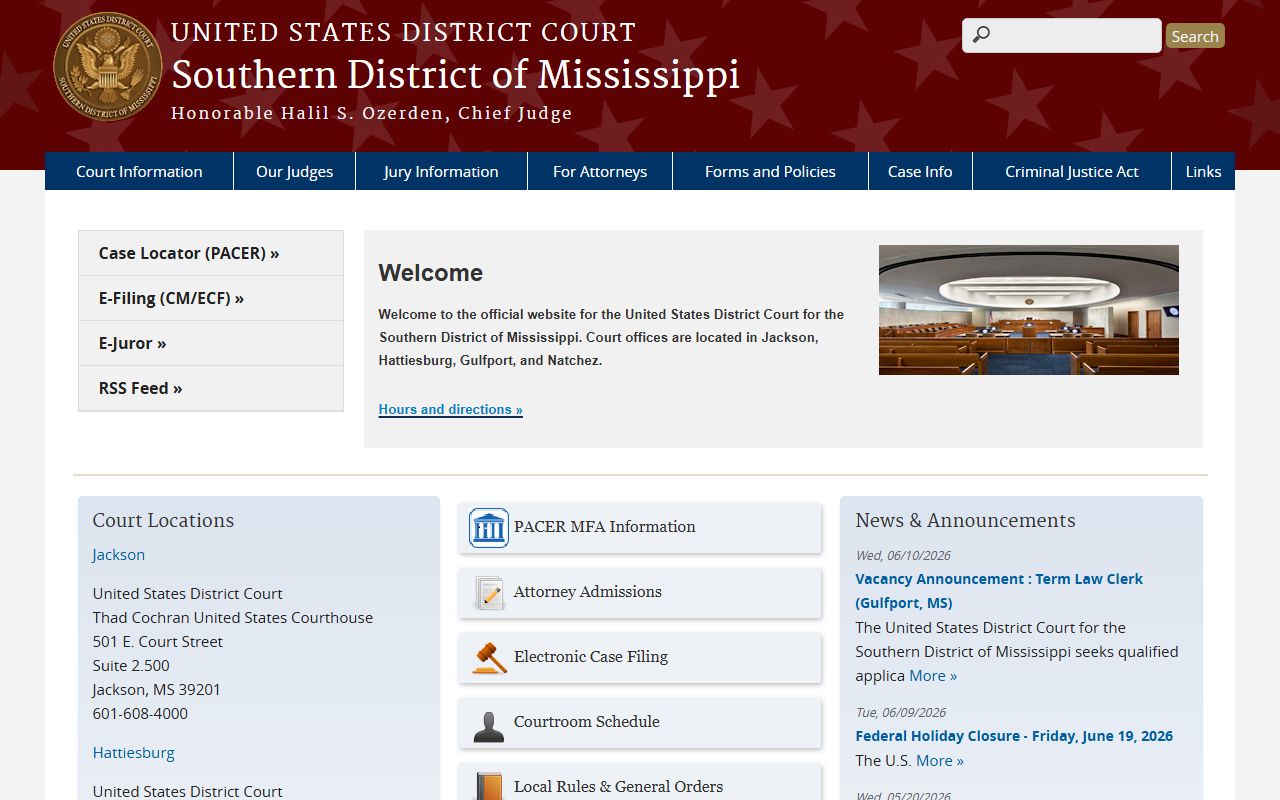
Not every crime in the county is a state case. A federal charge, such as a drug, firearm, or fraud offense brought under federal law, does not go to Circuit Court at all. Sharkey County falls inside the U.S. District Court for the Southern District of Mississippi, and those cases route through the federal system in Jackson rather than the Rolling Fork courthouse. The federal court keeps its own case files, and they are reached through different tools than MEC.
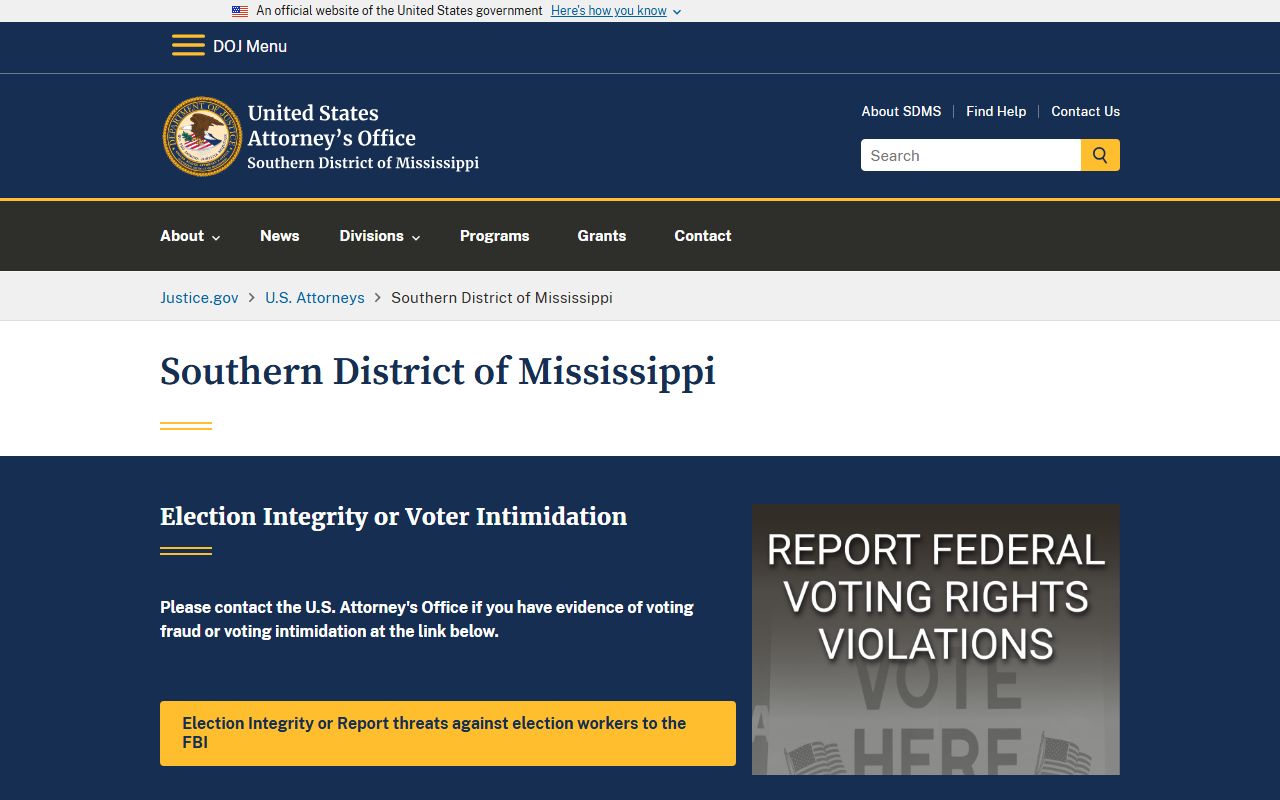
The starting point for federal matters is the U.S. District Court for the Southern District of Mississippi, which runs the trial court that hears federal crimes from the county. The court's site explains how filings, hearings, and dockets are managed.
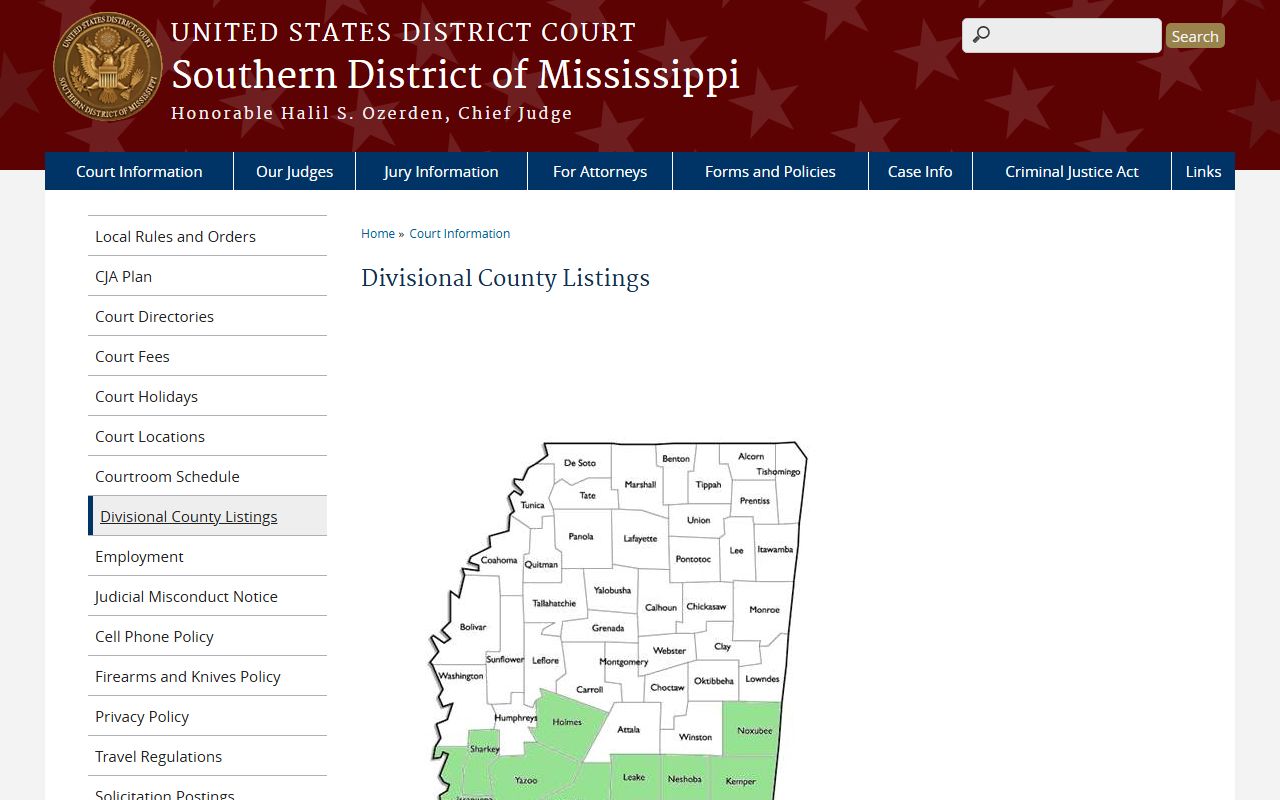
To confirm that Sharkey County sits in the right division, the court publishes a divisional county listing that maps each county to a division. The listing places Sharkey County in the Jackson area for federal filings.
Active federal case documents are filed and stored in the court's electronic system. The CM/ECF system for the Southern District is where attorneys file and where dockets are built. Account access is needed for full use.
Public users read federal dockets and documents through PACER, the national public access service for federal court records. PACER charges a per-page fee but covers criminal, civil, and bankruptcy files across the country.
The office that prosecutes those federal crimes is the U.S. Attorney for the Southern District of Mississippi. Its press releases and case notices often confirm the outcome of a federal prosecution tied to the region.
Sealed vs. Expunged Records
Sealing and expunction both pull a record out of public view, but they are not the same act. A sealed record still exists and can be reached by a narrow set of officials. An expunged record is treated as if the case never happened, and the court may tell a searcher that no public record exists. The table sets the two side by side, and the steps after it walk the Mississippi expunction path.
| Sealed | Expunged | |
|---|---|---|
| Visibility | Hidden from public view | Treated as if it never existed |
| Law Enforcement | Limited access remains | Very limited, tightly controlled |
| How It Happens | By statute or court order | By petition under Section 99-19-71 |
| Eligibility | Often youth, victim, or sealed-exhibit material | Eligible misdemeanors and some felonies after the sentence is done |
An expunction starts in the court that handled the case, which in Sharkey County may be Justice Court, Municipal Court, or Circuit Court depending on the charge. No local expunction packet or fee list was posted online, so a call to the clerk or a lawyer comes first. The steps below outline the usual path.
- Pull the exact case number, charge, disposition date, and the date the sentence was finished.
- Confirm the charge fits the eligibility rules in Section 99-19-71.
- File an expunction petition in the court that handled the case.
- Pay any filing fee unless it is waived, and give notice if the court requires it.
- The judge reviews eligibility and, if granted, signs an order to remove the record from public access.
Restricted Sharkey County Criminal Records
Some criminal court records are closed to the public no matter how the case ended. Youth court records are confidential under Mississippi law and are not searchable the way adult cases are. In Sharkey County, the Chancery Court holds youth jurisdiction, and access is limited to court officials, the parties, their lawyers, named agencies, or anyone a statute or judge allows. Sealed and expunged cases also fall outside ordinary search.
Beyond whole cases, parts of an otherwise open file may be held back or blacked out. Court staff may confirm that no public record exists rather than reveal a sealed detail. The categories below are the ones most often restricted.
- Youth court and juvenile delinquency files.
- Sealed warrants and active, ongoing investigations.
- Expunged charges and convictions.
- Victim and minor identifiers, addresses, and Social Security numbers.
- Medical, mental-health, and other sensitive personal details.
Background Check Considerations
A casual name search and a formal background check are not the same thing. A reader who looks up a single case for personal reasons sits in a different lane from an employer or landlord running a screening for a decision. Federal law draws that line. A regulated background check must follow the Fair Credit Reporting Act, which sets rules on consent, accuracy, and the chance to dispute an entry. Court records pulled straight from a clerk carry no such promise of completeness, since a case may be amended, appealed, or expunged after the copy is made.
Important: Sharkey County Court Records is not a consumer reporting agency under the FCRA, and nothing here may be used for credit, employment, tenant, or insurance decisions.