
Which Courts Handle Traffic Cases in Sharkey County
The county's official courts page is clear on venue. Traffic tickets written by the Mississippi Highway Patrol and the Sharkey County Sheriff's Department are resolved in Justice Court, along with gaming and fishing tickets. The same page places DUIs and violations of county ordinances in Justice Court as well. For most drivers stopped on a state highway or a county road, that means the case file sits with the Sharkey County Justice Court clerk.
City tickets follow a different path. If a citation was issued by a city police department under a city ordinance or inside a municipality, a Municipal Court may handle it, though no separate Rolling Fork municipal-court page was located. Appeals from a Justice Court or Municipal Court traffic case move up to Circuit Court. The table below maps the courts to the cases they hear.
| Court | Traffic Cases Handled | Address |
|---|---|---|
| Sharkey County Justice Court | Tickets from the Highway Patrol and the Sheriff's Department, gaming and fishing tickets, DUIs, county ordinance violations | 120 Locust Street, PO Box 235, Rolling Fork, MS 39159 |
| Municipal Court (if a city issued the ticket) | City police citations and city ordinance traffic written inside a municipality | Set by the issuing city; no separate Rolling Fork municipal court page was located |
| Circuit Court, 9th Judicial District | Appeals from Justice or Municipal Court traffic cases | 120 Locust Street, PO Box 218, Rolling Fork, MS 39159 |
How to Search Sharkey County Traffic Court Records
Sharkey County does not post a free, public traffic-case database. The county court page instead links to nCourt, the vendor it uses for Justice Court citation payment and lookup. The first move is always the same: read the ticket. The citation names the issuing agency and the court, and it prints the citation number that ties the whole case together.
Searching by citation number is the surest method, because that number points to a single case and avoids the confusion of common names. A name-only search can return several matches or none, and a small typo in the number can stall the lookup. Have the citation number, the driver name, and a date of birth ready before you start, then follow these steps.
- Read the citation to find the issuing agency and the court named on it. Highway Patrol and Sheriff's Department tickets route to Justice Court.
- Open the Sharkey County court page and use its link to the nCourt citation system for Justice Court matters.
- Enter the citation number when you have it, since that points to one case rather than a list of name matches.
- If the number is missing, call Justice Court with the driver name and date of birth and ask staff to locate the case.
- Review the charge, court date, plea, and disposition, then note any unpaid balance or failure-to-appear action before the deadline passes.
For non-traffic case types and a broader explanation of how the county's courts split their files, the Sharkey County court records page walks through the same channel-by-channel approach.
Citation Lookup Portal Search Fields
The county links to nCourt for Justice Court citations, but the live Sharkey portal could not be fully captured during review. A direct-access attempt returned a "No Org" style error rather than the search form, so the exact labels and required fields were not confirmed. The table below reflects the standard nCourt citation fields and marks where a detail was not verified for Sharkey.
| Field Label | Type | Required | Notes / Format |
|---|---|---|---|
| Citation number | Text | Likely yes | Not captured from the Sharkey nCourt page due to a direct-access error. Use the ticket number from the paper citation. |
| Defendant name | Text | Likely | Not confirmed for the Sharkey portal. |
| Date of birth | Date / text | Possible | Not confirmed. |
| Payment amount | Calculated | Yes when paying | Amount depends on the ticket, fines, and court costs. |
| Search / Continue / Submit | Button | Yes | Button labels were not confirmed for Sharkey; the page returned an access error in place of the form. |
Because the fields above are not verified, the safest backup is a phone call to the Justice Court clerk, who can confirm the case and the amount due before any payment goes through.
Types of Traffic Cases on Record
Justice Court records cover a wide range of road and license violations, not just speeding. The county also folds gaming and fishing tickets into the same court, which is unusual enough to note. The common categories that show up in a Sharkey County traffic court records search include the following.
- Moving violations - speeding, running a stop sign or light, careless driving, and following too closely.
- Non-moving and equipment - broken lights, an expired tag, no proof of insurance, and similar fix-it issues.
- License and registration - driving without a valid license, a suspended or expired license, and tag or registration problems.
- Wildlife and gaming - fishing and gaming tickets, which the county lists among Justice Court matters.
- County ordinance - local rules the county enforces that fall outside the state traffic code.
- DUI - driving under the influence, which routes to Justice Court but is handled as a criminal charge.
What Sharkey County Traffic Court Records Show
A traffic case file is built around the citation and the steps the court took to resolve it. The record links the driver, the offense, and the outcome, and it flags whether money is still owed or a warrant has issued. The field inventory below shows what a Sharkey County traffic court record typically holds.
| Field | What It Shows |
|---|---|
| Citation Number | The unique number printed on the ticket; ties every entry to one case. |
| Issuing Agency | Whether the Highway Patrol, the Sheriff's Department, or a city agency wrote the ticket. |
| Charge / Offense | The violation cited, such as speeding or no insurance, often with a code section. |
| Court | The court that holds the case, usually Justice Court for a county ticket. |
| Court Date | The hearing or appearance date set for the citation. |
| Plea / Disposition | How the case was answered and closed: paid, guilty, not guilty, or dismissed. |
| Fine and Court Cost | The amount assessed, which varies by offense and is not posted online. |
| Status | Whether the matter is open, paid, in default, or carries a warrant or license hold. |
Note: a court file shows how one citation was handled, but it does not stand in for a full driver history kept by the state.
How to Pay or Contest a Sharkey County Traffic Ticket
Whether to pay or fight a ticket is a choice with real consequences, because paying a fine usually counts as a guilty plea. Sort out the issuing agency and the court first, then decide. The steps below follow the county's own guidance for a Sharkey traffic citation.
- Read the citation to identify the issuing agency and the court. Highway Patrol and Sheriff's Department tickets route to Justice Court.
- To pay, use the pay-Justice-Court-citations link on the county court page or call Justice Court before the due date.
- To contest, do not pay, since payment usually acts as a guilty disposition. Call Justice Court to ask how to plead not guilty and to confirm a court date.
- For a DUI, county ordinance, or misdemeanor ticket, ask whether a personal appearance is required.
- If you missed court or left a fine unpaid, ask Justice Court whether a bench warrant, a capias, or a license hold has issued.
- For driver-license effects, check your Mississippi driver record on its own, because the court file and the MVR are different records.
Court Traffic Record vs State Driver Record
This is the distinction that trips up most people. The court traffic record is the case file for a single citation, kept by the court that handled it. The state driver record, or MVR, is a separate history kept by the Mississippi Department of Public Safety that tracks license status and convictions over time. A dismissed ticket may close the court file yet still need a look at the MVR to confirm nothing landed on the license. The grid below lines up the two records point by point.
| Comparison Point | Court Traffic Record | State Driver Record (MVR) |
|---|---|---|
| Record source | The Justice Court or Municipal Court that handled the citation | The Mississippi DPS Driver Service Bureau |
| What it shows | Citation, charge, issuing agency, court date, plea, disposition, fine and cost, payment or warrant status | Driver identifying data, license status, and convictions or driver history as kept by DPS, available as a certified MVR |
| Where to access | The court clerk by phone or in person, or the county online citation system | The DPS Driver Service Bureau online MVR portal |
| How to correct errors | Contact the court that entered the disposition and ask the clerk to review the case file | Contact the DPS Driver Service Bureau, since the MVR reflects what the state has recorded |
Mississippi runs its driver-record service through the state's online portal. Drivers can reach it at the Mississippi DPS motor vehicle record portal, which is the official front door for ordering a record. That portal is a state resource, separate from any Sharkey County traffic court records held by the local clerk.
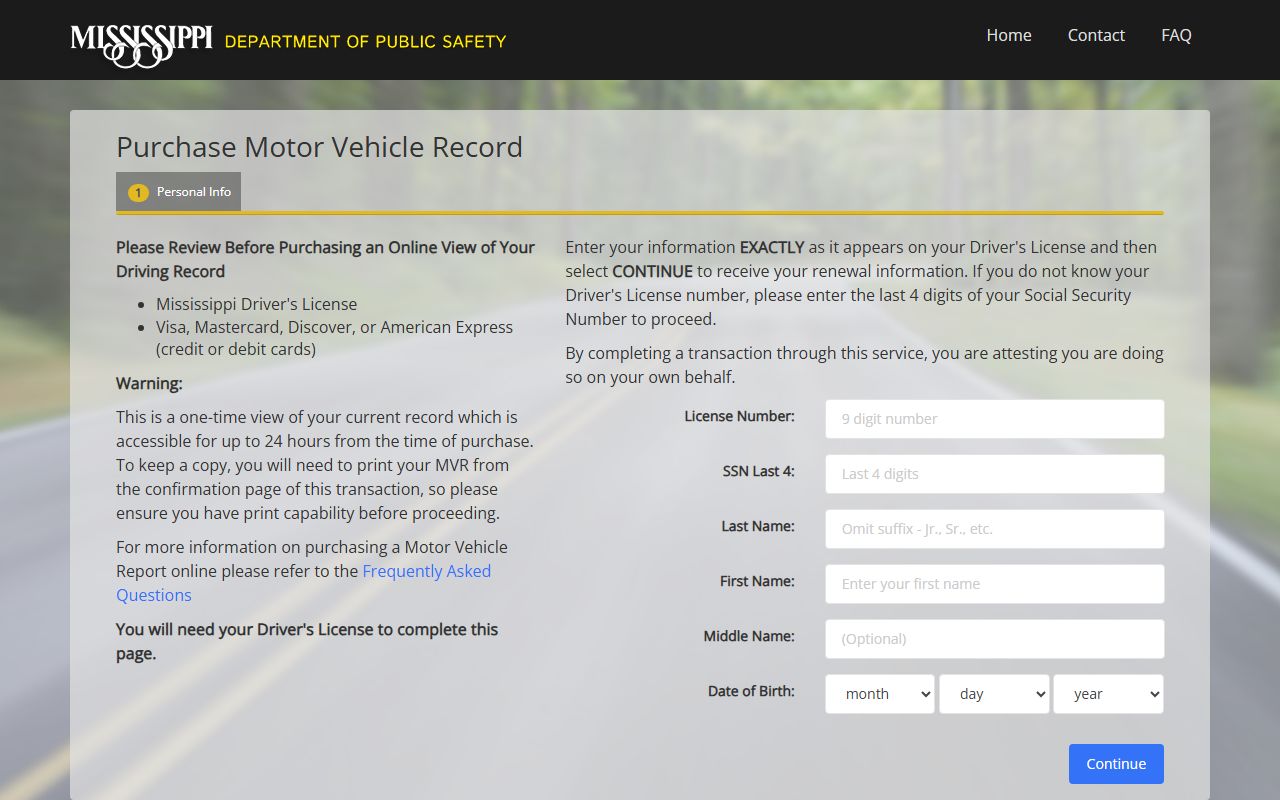
Pulling the MVR after a citation is resolved is the only sure way to see what reached the license, since the court file and the state record are updated by different offices.
Ordering a Mississippi Driver Record (MVR)
The Mississippi DPS Driver Service Bureau is the office that issues a driver record. A certified MVR is the document an employer, insurer, or court may ask for, and it shows license status and driver history as the state has recorded it. The bureau's online home is the starting point for the request. Begin at the Mississippi Driver Service Bureau records home page.
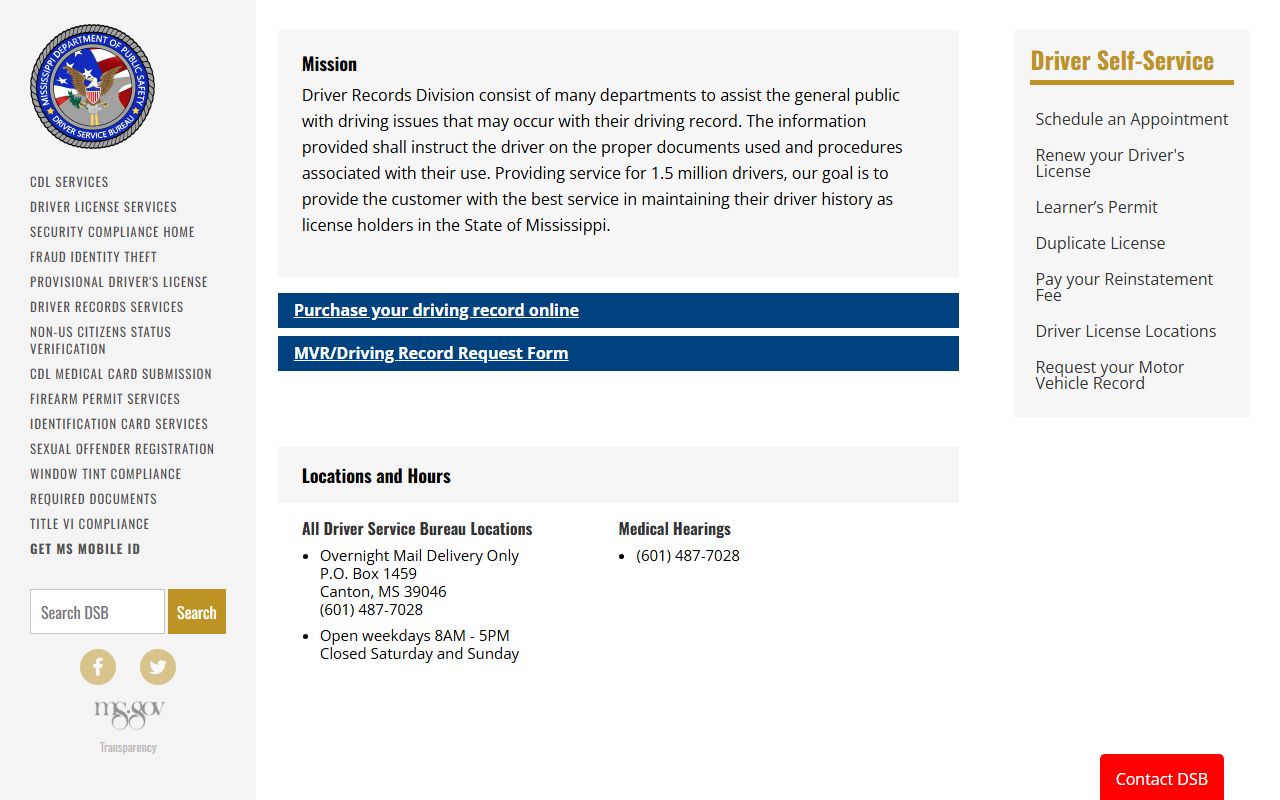
That page sets up the request and routes a driver to the right transaction. To pull the record, the portal asks for the identifiers in the table below, which a driver can supply straight from a license.
| Field Label | Type | Required | Notes / Format |
|---|---|---|---|
| License Number | Text | Required unless using SSN last 4 | Enter exactly as it appears on the license. |
| SSN Last 4 | Text | Alternative | If the license number is unknown, enter the last four of the SSN. |
| Last Name | Text | Yes | As shown on the driver license. |
| First Name | Text | Yes | As shown on the driver license. |
| Middle Name | Text | Optional | Enter if it applies, as shown on the license. |
| Date of Birth | Date | Yes | Enter the driver date of birth. |
| Continue | Button | Yes | The portal proceeds to the transaction. |
The bureau also runs a department page that explains the record types and the request process. The Motor Vehicle Record Department page lays out who can order a record and how it is delivered.
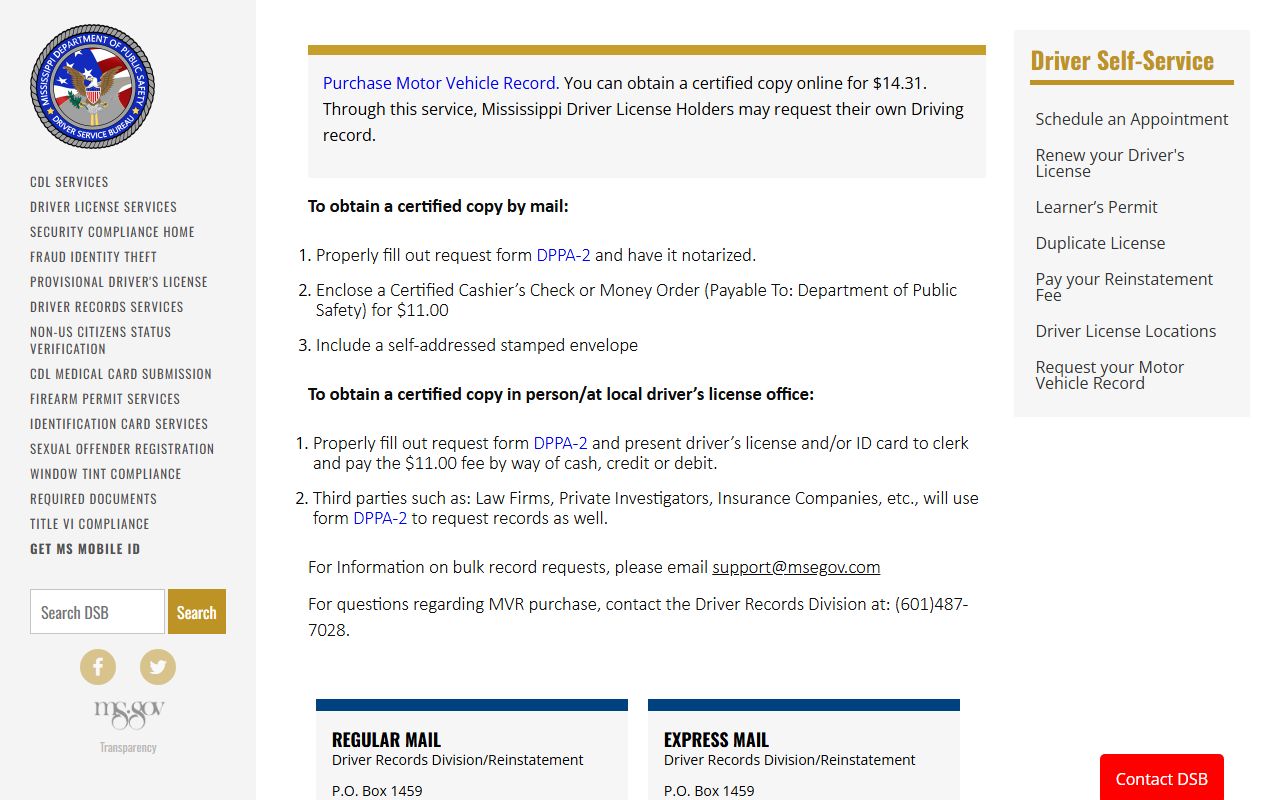
Reading that page first sets expectations on cost and turnaround, so a driver checking on a Sharkey County citation knows what the state record will and will not include.
CDL and Commercial Driver Records
Commercial drivers face stricter rules than other motorists, and a traffic conviction can carry more weight for a CDL holder. Federal rules limit the masking of convictions for commercial drivers, so a violation that an ordinary driver might keep off the record through a diversion program can still reach a CDL driver record. A serious or repeat offense can lead to a disqualification that sits outside the local court file. Because Sharkey County tickets for the Highway Patrol and the Sheriff's Department resolve in Justice Court, a CDL holder should both confirm the court disposition and pull the state MVR, since the two records can show different things and an employer usually relies on the MVR.
DUI and DWI Cases
A DUI is not an ordinary traffic ticket. The county routes DUIs to Justice Court, but a DUI is charged and tracked as a criminal matter, with the appearance rules and consequences that come with a misdemeanor or felony charge rather than a simple fine. For a DUI, ask whether a personal appearance is required before any deadline passes.
For full Sharkey County DUI and DWI case information, see the Sharkey County criminal court records page.
Public Access Laws for Traffic Court Records
Traffic case files are public records in most respects, and access starts with the office that holds the file. The Mississippi Public Records Act treats county records as open for inspection unless a specific law exempts them, which supports a request to the Justice Court clerk for a citation or disposition. The act does not override sealing orders, expunctions, or youth-court confidentiality.
Key Statutes:
Miss. Code Ann. § 25-61-1 - the Mississippi Public Records Act makes county public records open for inspection unless a specific law restricts them.
Miss. Code Ann. § 99-19-71 - sets when an eligible misdemeanor or traffic conviction may be expunged through the court of conviction.
The state also publishes a public-records help center for driver and DPS records. Drivers can review common questions at the Mississippi DPS public-records FAQ page before filing a request for a state-held record.
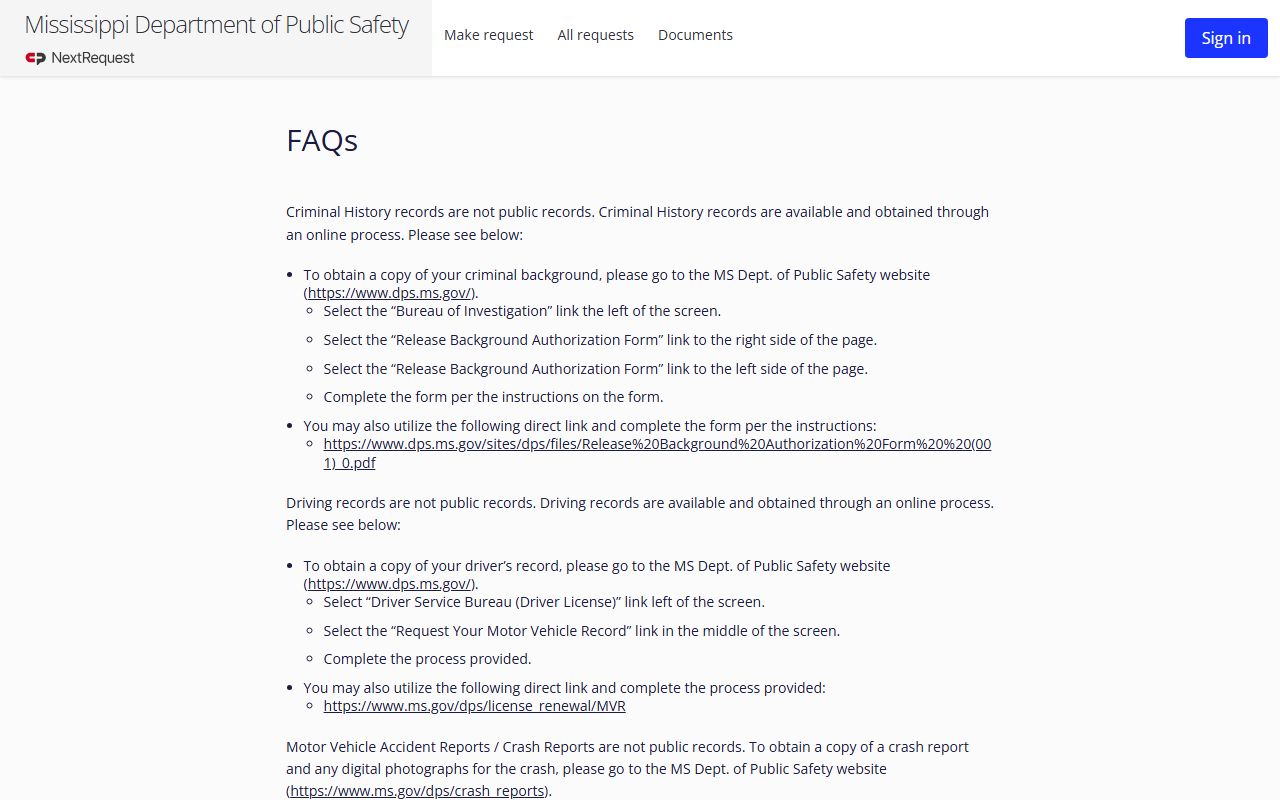
That FAQ covers the state side of the request, which is a separate channel from asking the Sharkey County Justice Court clerk for a local citation file.
Sealing or Expunging Traffic Records
Clearing an eligible traffic or misdemeanor conviction is its own court process, separate from paying or appealing a ticket. An expunction begins in the court of conviction, which for a Sharkey County citation is usually Justice Court or a Municipal Court. Eligibility runs through Miss. Code Ann. Section 99-19-71, which sets the conditions for removing a qualifying conviction from public access. A petitioner should first pin down the case number, the charge, the disposition date, and the date any sentence was completed, then file under the statute and let the judge decide eligibility. No Sharkey-specific expunction packet or local filing fee is posted online, so call the Justice Court clerk or an attorney before filing. An expunction reaches the court file; it does not automatically change the separate state driver record, which should be reviewed on its own.
Fees for Traffic Records and Driver Records
Sharkey County does not post a traffic fine schedule or a court copy fee online, so the amounts that are confirmed are limited. The one verified figure is the state's price for a certified driver record. The fine and any court copy charge vary by offense and should be confirmed by phone before paying, since payment can act as a guilty plea.
| Item | Amount |
|---|---|
| Citation fine and court costs | Varies by offense; not posted online. Call Justice Court. |
| Online payment service fee | Set by the payment vendor; not posted. Confirm before paying. |
| Certified Mississippi driver record (MVR) | $14.31 online through the DPS Driver Service Bureau |
| Certified court copy | Not posted in Sharkey sources. Call Justice Court. |
Note: confirm a fine and the amount due with the Justice Court clerk before paying, because an online payment can close a case as a guilty disposition.