
Sharkey County Circuit Court Overview
In Mississippi, the Circuit Court is the general trial court of broad power. It hears felony crimes, civil lawsuits not placed by law in another court, and appeals that rise from the County, Justice, Municipal, and administrative bodies below it. Most cases that reach a jury in Sharkey County are tried here. The court does not handle divorce, child custody, estates, or land title fights. Those belong to Chancery Court, which is the equity and family side of the system.
Sharkey County falls in the 9th Judicial District. Two elected judges preside over the district, Hon. M. James Chaney, Jr. and Hon. Toni Walker Terrett. They share the bench across the counties that the district covers, and they hold terms of court at the Sharkey County Courthouse in Rolling Fork. The same building holds Chancery Court and Justice Court, so the address is shared, but the case types and judges are not.
The Mississippi Judiciary keeps a plain-language explainer of what these trial courts do. The state describes how the Circuit Court hears felony cases, civil suits, and appeals from the lower courts.
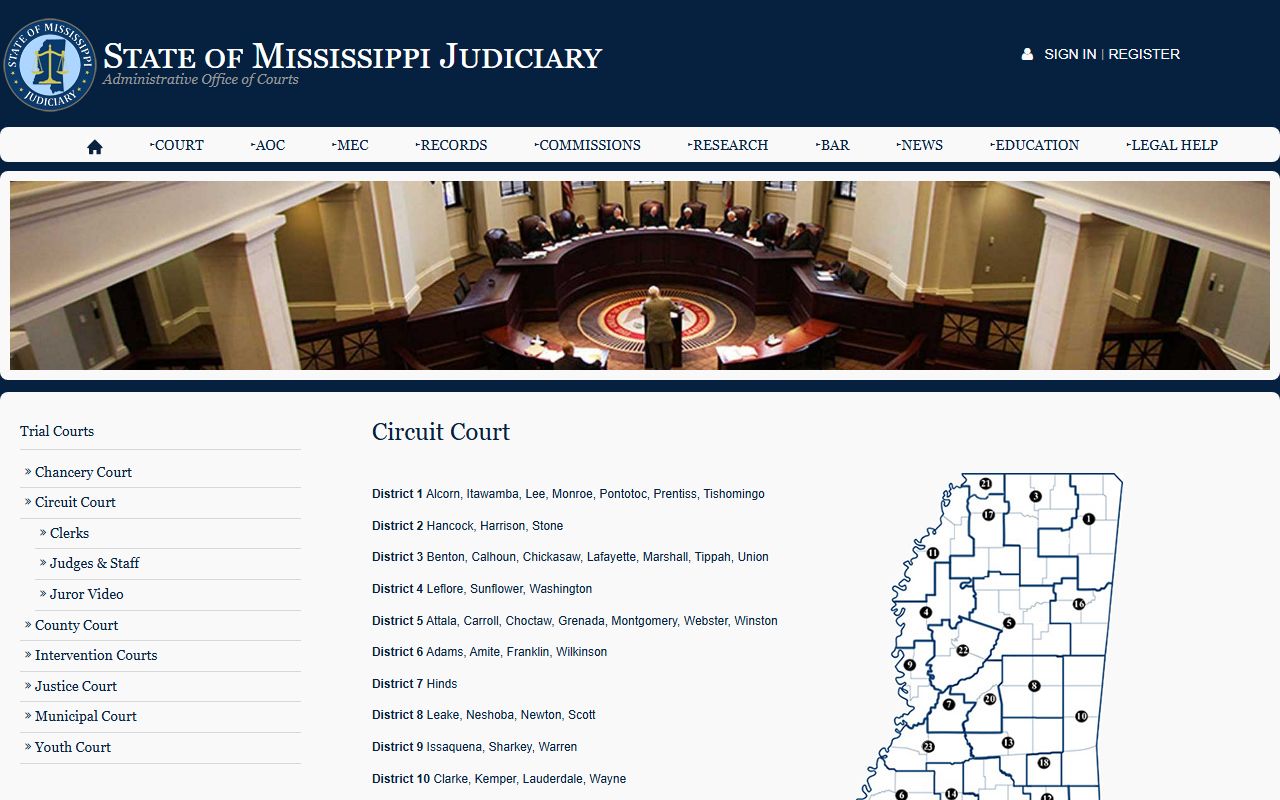
That state page mirrors what local Sharkey County sources list for the 9th Judicial District: original jurisdiction over civil and criminal matters not vested exclusively elsewhere, with juries deciding most contested trials.
Sharkey County Trial Courts Table
Sharkey County does not run a numbered set of district courts the way some states do. Instead, three trial courts sit at 120 Locust Street in Rolling Fork, each with its own job. The Circuit Court is the felony and major-civil court. The Chancery Court is the equity and family court. The Justice Court is the local lower court for small claims, tickets, and the first steps of a felony case. The table below shows each court, the district it belongs to, the judges, the address and phone, and the kinds of cases it keeps.
| Court | District | Judges | Address / Phone | Jurisdiction |
|---|---|---|---|---|
| Circuit Court | 9th Judicial District | Hon. M. James Chaney, Jr.; Hon. Toni Walker Terrett | 120 Locust St, PO Box 218, Rolling Fork, MS 39159; 662-873-2755 | Felony crimes, civil cases not vested exclusively elsewhere, and appeals from lower courts; most cases tried by jury. |
| Chancery Court | 9th Chancery District | Hon. Bennie L. Richard; Hon. Vicki Barnes; Hon. Debra M. Giles | 120 Locust St, PO Box 218, Rolling Fork, MS 39159; 662-873-2755 | Divorce, custody, alimony, adoption, estates, guardianships, land and title disputes, property disputes over $50,000, commitments, and juvenile matters. |
| Justice Court | Sharkey County | Post 1 Hon. Charles L. Smith; Post 2 Hon. Elvis Clark Secoy; Clerk Princess Bethely | 120 Locust St, PO Box 235, Rolling Fork, MS 39159; 662-873-6140 | Civil claims of $3,500 and under, evictions, sheriff and highway-patrol tickets, DUIs, county ordinances, and felony initial appearances. |
Note: Sharkey County has no separate County Court, so juvenile and shared-jurisdiction matters that a County Court would hear elsewhere route to Chancery Court here.
Circuit Court vs Chancery Court vs Justice Court
The fastest way to find a record is to match the case to the right court. The three Rolling Fork trial courts split the work by subject, by dollar amount, and by how serious the charge is. Circuit Court takes the heavy criminal and civil load. Chancery Court takes family and equity. Justice Court takes small, fast, local matters. The grid below lays the three side by side so the lines are clear.
| Circuit Court | Chancery Court | Justice Court | |
|---|---|---|---|
| Case types | Felonies, civil suits not vested elsewhere, appeals from below | Divorce, custody, estates, guardianships, land title, equity | Small claims, evictions, tickets, misdemeanors, first appearances |
| Civil or criminal | Both | Civil and family only | Both, but minor |
| Appeals | Hears appeals from Justice and Municipal Court; its own rulings go to the state appellate courts | Rulings go to the state appellate courts | Appeals go up to Circuit Court |
| Examples | Armed robbery trial, a $200,000 injury suit | A contested divorce, settling a will | A $1,500 debt claim, a speeding ticket |
The Mississippi Judiciary keeps a matching page for the equity side. Its overview of the Chancery Court and its family and probate work shows why a divorce or estate file is never found in Circuit Court records.
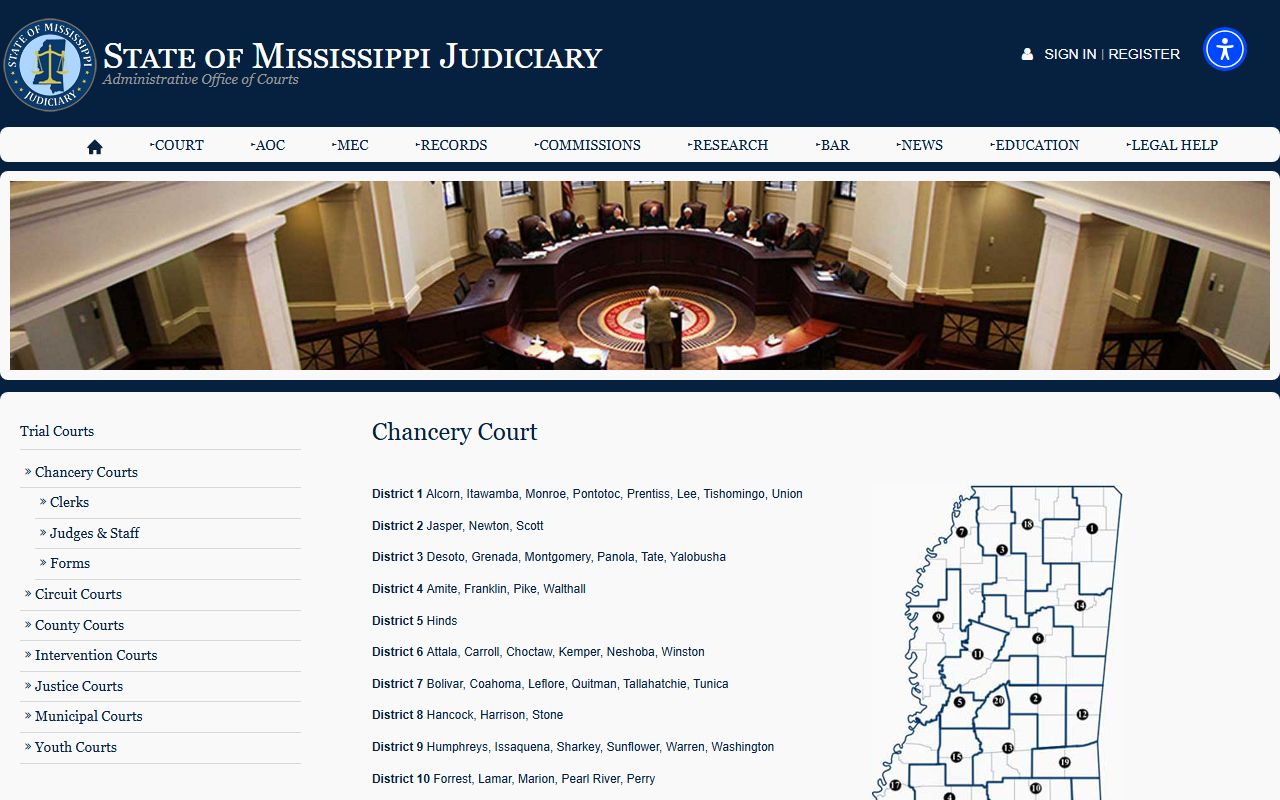
For anyone tracing a Sharkey County case, that split means a name search may hit one court and miss the others. A person can be a felony defendant in Circuit Court and a party to a divorce in Chancery Court at the same time, and the two files sit in different places.
How a Case Moves Through the System
A criminal case rarely starts and ends in one court. It often begins with an arrest and a first appearance in Justice Court, where a judge sets bond and reads the charge. The Justice Court judges hold sessions at the jail three times each week so that arrested people get an initial appearance within three days. The case then moves to Circuit Court once a grand jury hands up an indictment, and that is where the trial and sentencing happen. From there, a losing party can ask the state appellate courts to review the result.
Criminal path: Arrest › Justice Court first appearance › Grand jury indictment › Circuit Court arraignment › Pretrial › Trial › Sentencing › Court of Appeals › Supreme Court
Appeals path: Justice Court or Municipal Court ruling › Circuit Court › Court of Appeals › Supreme Court
Civil disputes follow their own line. A complaint is filed with the Circuit Clerk, the other side answers, the parties trade discovery, and the judge or jury decides. Because the path crosses more than one court, a full record search may need the sheriff for booking detail, the Justice Court for the first appearance, and the Circuit Court for the indictment and outcome. The day-by-day steps of an active case show up in the Sharkey County court dockets.
The 9th Judicial District and Its Jurisdiction
Mississippi groups its 82 counties into numbered circuit districts, and Sharkey County sits in the 9th Judicial District. A district can cover more than one county, so the same two judges hear cases across the region and travel to each county seat for terms of court. The District Attorney for the 9th Circuit District prosecutes the felony docket, and his office covers Sharkey, Issaquena, and Warren counties.
The Circuit Court's reach is wide. It takes original jurisdiction over civil and criminal matters that the law has not handed to another court. That includes felony prosecutions, larger personal-injury and contract suits, and the review of decisions made by county boards and state agencies. It also serves as the appeal court for cases first decided in Justice Court and Municipal Court.
Mississippi rounds out its trial level with County Courts, which exist only in some counties. The state explains the role of the County Court in the wider hierarchy, which helps show what Sharkey County does without.
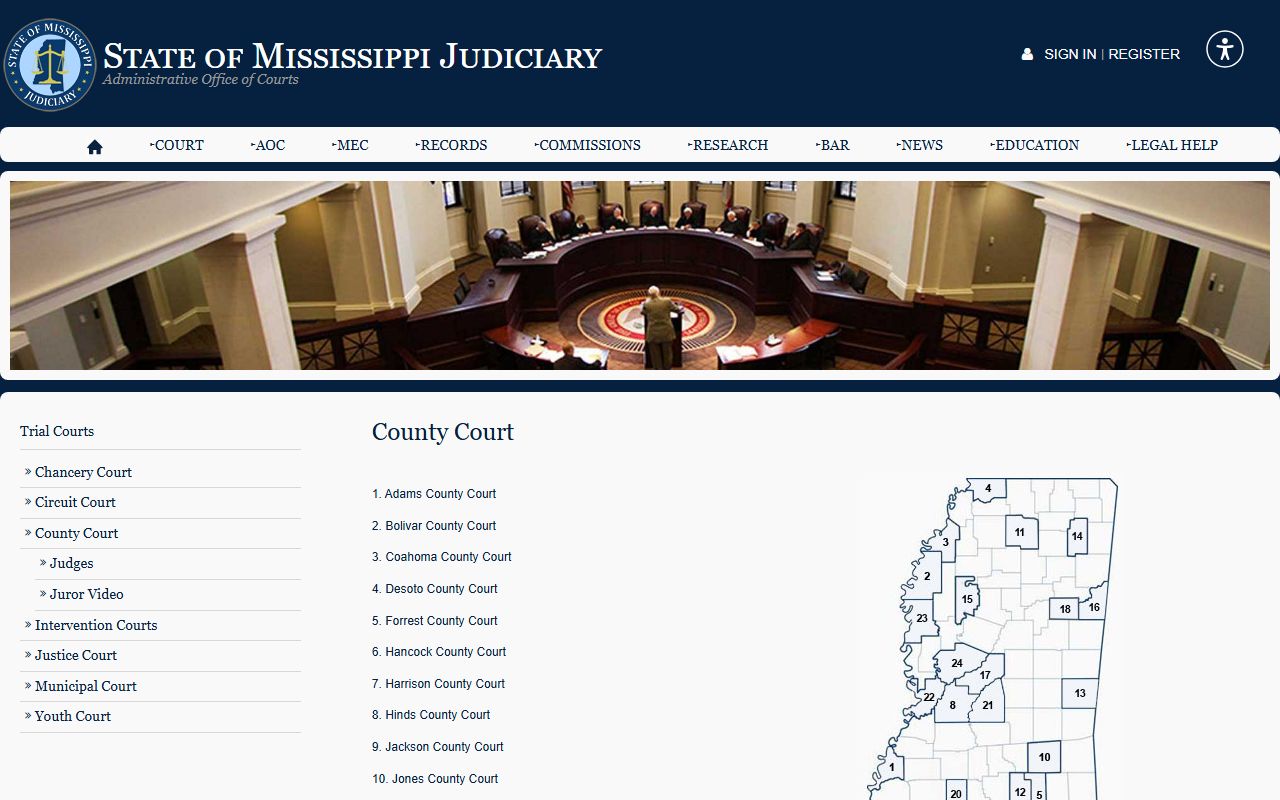
Since no County Court was set up in Sharkey County, the Circuit Court and Chancery Court absorb the work that a County Court might carry in a larger county, and juvenile matters route to Chancery Court.
Circuit Court Judges and Address
The Circuit Court for Sharkey County meets at the historic Sharkey County Courthouse, a 1902 building that the state named a Mississippi Landmark in 1989. The Circuit Clerk, Murindia Williams, keeps the court's files, issues process, and draws the juries. A March 2023 tornado damaged the Rolling Fork courthouse area, so callers should confirm hours before they travel for a hearing or a records visit.
Sharkey County Circuit Court, 9th Judicial District
120 Locust Street
PO Box 218
Rolling Fork, MS 39159
Phone: 662-873-2755
Fax: 662-873-6045
Email: cc@sharkeycountyms.gov
Judges: Hon. M. James Chaney, Jr.; Hon. Toni Walker Terrett
A few terms come up often in Circuit Court files. The short list below defines them in plain words.
- Indictment
- The formal charge a grand jury hands up to start a felony case in Circuit Court.
- Arraignment
- The first Circuit Court hearing where the defendant hears the charge and enters a plea.
- Disposition
- The final result of a case, such as a verdict, a plea, or a dismissal.
- Execution
- The court process that enforces a money judgment after a civil case ends.
The Criminal Case Path in Circuit Court
Felony charges are the core of the Circuit Court's criminal docket. The file grows step by step, from the indictment through the sentence, and each stage adds documents the clerk keeps. Someone tracing a felony record should expect the case to cross from Justice Court into Circuit Court along the way.
- A grand jury reviews the evidence and returns an indictment, which formally charges the felony.
- The defendant is arraigned in Circuit Court and enters a plea of guilty or not guilty.
- The lawyers file pretrial motions, trade discovery, and may discuss a plea.
- The case is tried before a jury, or it is resolved by a plea agreement.
- The judge enters the disposition and, on a conviction, imposes a sentence.
The full charge-by-charge file, with pleas, hearings, and the sentence, sits in the Sharkey County court records held by the Circuit Clerk. State prison sentences are served through the Mississippi Department of Corrections rather than the county jail.
The Civil Case Path in Circuit Court
Circuit Court also handles civil disputes that the law does not assign to another court. These are usually larger money claims, such as injury suits, contract fights, and damage actions, along with appeals from county boards and state agencies. Smaller claims of $3,500 and under start in Justice Court instead.
A civil case opens when the plaintiff files a complaint with the Circuit Clerk and pays the filing cost. The clerk issues a summons, and the sheriff or a process server delivers it to the defendant. The defendant files an answer, the parties exchange information through discovery, and many cases settle before trial. If the case does go to trial, a jury or the judge decides it, and the court enters a judgment.
A losing party who wants the money owed can ask the clerk to issue an execution, which the sheriff uses to collect on the judgment. Civil files are public unless a judge has sealed them or a statute keeps them closed.
Appeals and Jury Trials
The Circuit Court works as both a trial court and an appeal court. When a person loses in Justice Court or Municipal Court, the appeal moves up to Circuit Court, where the case is often heard fresh. When a party loses in Circuit Court itself, the next step is the Mississippi Court of Appeals, and from there the Mississippi Supreme Court. City ordinance and city traffic cases that begin in a Municipal Court follow this same upward path into Circuit Court.
Juries are central to Circuit Court. Most contested trials here are decided by a jury, and the Circuit Clerk draws and qualifies the jurors. People summoned for jury duty should follow the instructions on the summons and call the Circuit Clerk with questions about a date or an excuse.
The Municipal Court level is one of the sources that feeds appeals upward. The Mississippi Judiciary describes how Municipal Courts handle city ordinances and traffic before a contested case can climb to Circuit Court.
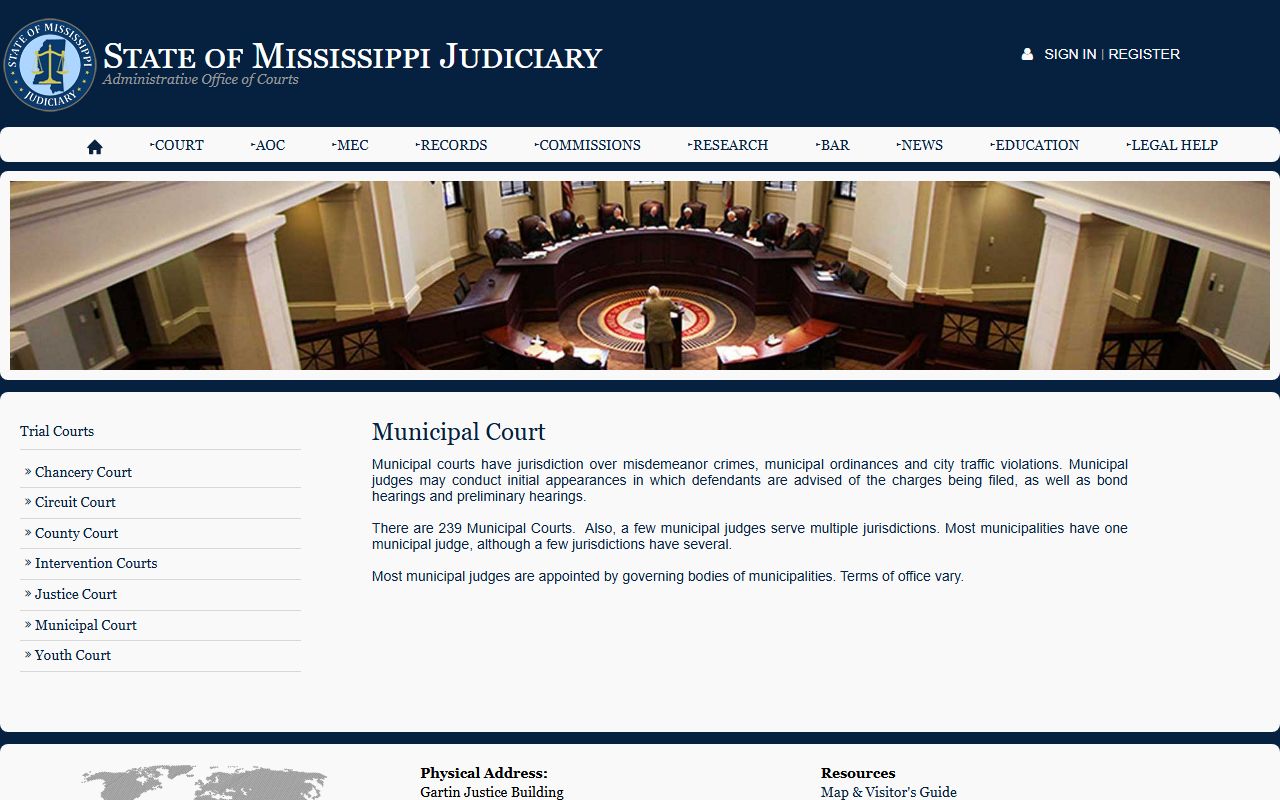
Because a Municipal Court ruling can be appealed into Circuit Court, a complete search for a city-issued charge may need both the city clerk who first handled it and the Circuit Court that reviewed it on appeal.
Federal Cases From Sharkey County
Federal matters do not pass through the Circuit Court at all. Sharkey County falls within the U.S. District Court for the Southern District of Mississippi, and the county is listed in the Jackson Division. Federal crimes, federal civil-rights suits, and federal-question lawsuits are filed there, not at the Rolling Fork courthouse.
Records for those cases live in the federal system. The Southern District of Mississippi handles the filings, and its public docket access runs through PACER. Federal appeals go to the U.S. Court of Appeals for the Fifth Circuit. These files stay fully separate from the county Circuit, Chancery, and Justice Court records.