
How to Search Sharkey County Court Records
Sharkey County does not run a single free case-search website of its own, so finding a Sharkey County court record means knowing which channel holds it. The main online path for trial-court cases is Mississippi Electronic Courts, the statewide e-filing system known as MEC. The county Chancery Clerk page links to MEC for the 9th Chancery District, and the state judiciary now runs MEC across all Circuit, Chancery, and County Courts. Access calls for a login, and some document views may carry a fee.
Gather a few details before you start. A full party name, an approximate filing or incident date, a case or citation number, and the issuing agency all sharpen a search. For a criminal matter, a date of birth helps. When the case is older or sealed, the clerk's counter often works better than any screen.
- Identify the court level from the record. Felonies and large civil suits go to Circuit Court, divorce and probate go to Chancery Court, and tickets, small claims, and evictions go to Justice Court.
- Collect identifiers: party name, case or citation number, filing date, and the agency that issued any ticket or affidavit.
- Check MEC for Circuit and Chancery case information, and be ready to register or pay to view documents.
- Call or write the Circuit Clerk or Chancery Clerk when MEC shows no match, the file is old, or the record may be restricted.
- For county tickets and small claims, contact Justice Court or use the county page's citation-payment link, then ask the per-page and certification fees before ordering copies.
The official county website is the front door to most of these office links and phone numbers, and you can reach it through the Sharkey County government home page.
That portal routes visitors to the Circuit Clerk, Chancery Clerk, Justice Court, and Sheriff pages that anchor every Sharkey County records request.
The Sharkey County Judicial System
Mississippi spreads trial work across several courts, and Sharkey County uses three of them at 120 Locust Street in Rolling Fork. The Sharkey County court structure is compact but layered. Circuit Court is the general trial court for felonies, larger civil disputes, and appeals from the lower courts. Chancery Court is the equity court, where divorce, child custody, probate, guardianship, and land matters are heard. Justice Court handles small claims up to $3,500, misdemeanors, county traffic tickets, DUIs, and the first appearance in felony cases. Municipal courts handle city matters where a town has one.
Sharkey County has no County Court, so the middle node many larger counties use does not exist here. Circuit Court sits in the 9th Judicial District with Judges M. James Chaney, Jr. and Toni Walker Terrett. Chancery Court sits in the 9th Chancery District with Judges Bennie L. Richard, Vicki Barnes, and Debra M. Giles. Above the trial level sit the Mississippi Court of Appeals and, at the top, the Mississippi Supreme Court.
Case flow: Justice Court › Circuit Court › Court of Appeals
| Court | Level | What It Handles |
|---|---|---|
| Supreme Court | Court of last resort | Final state appeals |
| Court of Appeals | Intermediate appellate | Assigned appeals from trial courts |
| Circuit Court | General trial court | Felonies, major civil cases, lower-court appeals |
| Chancery Court | Equity trial court | Divorce, probate, guardianship, land, juvenile |
| Justice Court | Limited trial court | Small claims, misdemeanors, county traffic, DUIs |
The county's own breakdown of these courts and judges appears on the Sharkey County courts page, which lists the address and bench for each level.
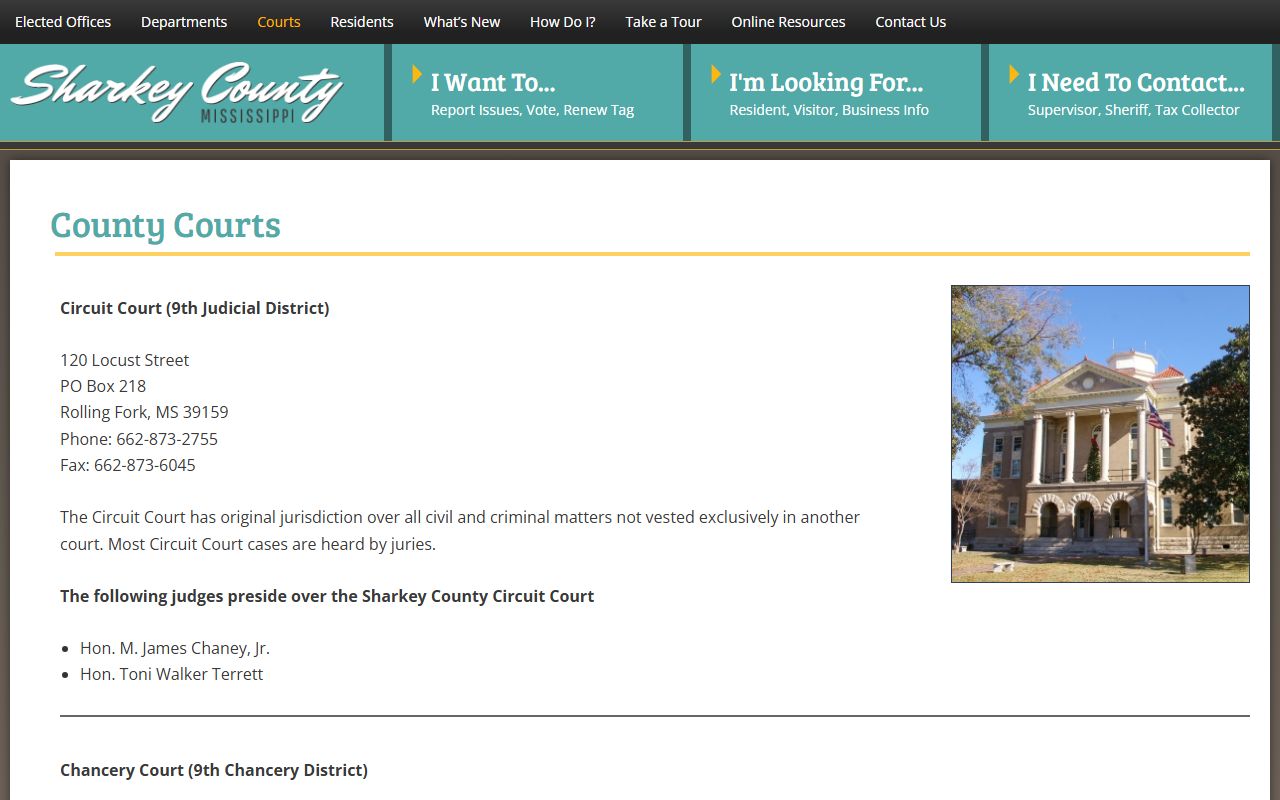
That single page confirms all three courts share the Locust Street courthouse, which keeps records access centered on one civic building.
Types of Court Records Available in Sharkey County
The records a court keeps follow the cases it hears. Because Sharkey County splits work across three trial courts, the type of Sharkey County record you want tells you which clerk to call. Criminal files, large civil suits, family cases, probate estates, and traffic tickets each live in a different place, though all sit under the same roof.
Charging decisions in felony cases rest with the prosecutor, and the District Attorney for the 9th Circuit District covers Sharkey, Issaquena, and Warren counties. The county also has a County Prosecutor for lower-court matters. The roles these officials play are described on the Sharkey County District Attorney page.
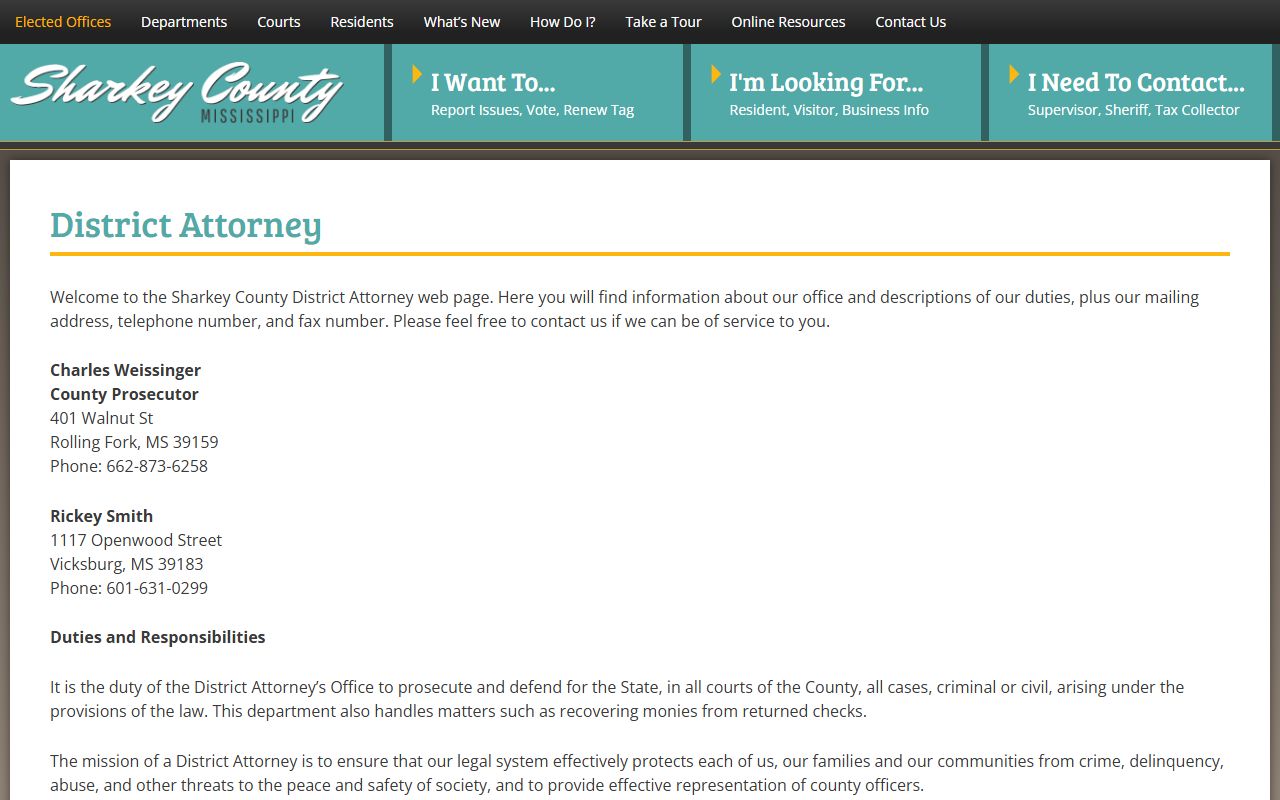
Knowing who prosecutes a case helps when a record shows a charge filed, amended, or dropped, since the prosecutor drives those changes while the judge signs the orders.
- Criminal records - Circuit Court felony files and Justice Court misdemeanor cases, with charges, pleas, and disposition.
- Civil records - Circuit Court lawsuits and Justice Court claims of $3,500 and under, including evictions and judgments.
- Family and divorce records - Chancery Court divorce, custody, alimony, and property-division files.
- Probate records - Chancery Court estates, wills, guardianships, and conservatorships.
- Traffic records - Justice Court tickets from the Sheriff and Highway Patrol, plus DUIs and county ordinances.
The table below compares the three Sharkey County trial courts side by side so the right venue is clear before a search begins.
| Feature | Circuit Court | Chancery Court | Justice Court |
|---|---|---|---|
| Core role | General trial court | Equity and family court | Limited civil and minor criminal |
| Criminal reach | Felonies | None | Misdemeanors, DUIs, first appearances |
| Civil reach | Major civil suits | Divorce, probate, land, equity | Claims of $3,500 and under, evictions |
| Clerk | Circuit Clerk | Chancery Clerk | Justice Court Clerk |
What Sharkey County Court Records Show
A court file is built from many parts, and the fields repeat across case types. A reader who knows the layout can move from a docket sheet to a specific order without guessing. Most files open with a case number and the names of the parties, then track every filing, hearing, and ruling in date order.
The Circuit Clerk, Murindia Williams, files lawsuits, indictments, motions, judgments, and executions, and also issues marriage licenses and qualifies juries. The duties that shape a Sharkey County case record appear on the Sharkey County Circuit Clerk page.
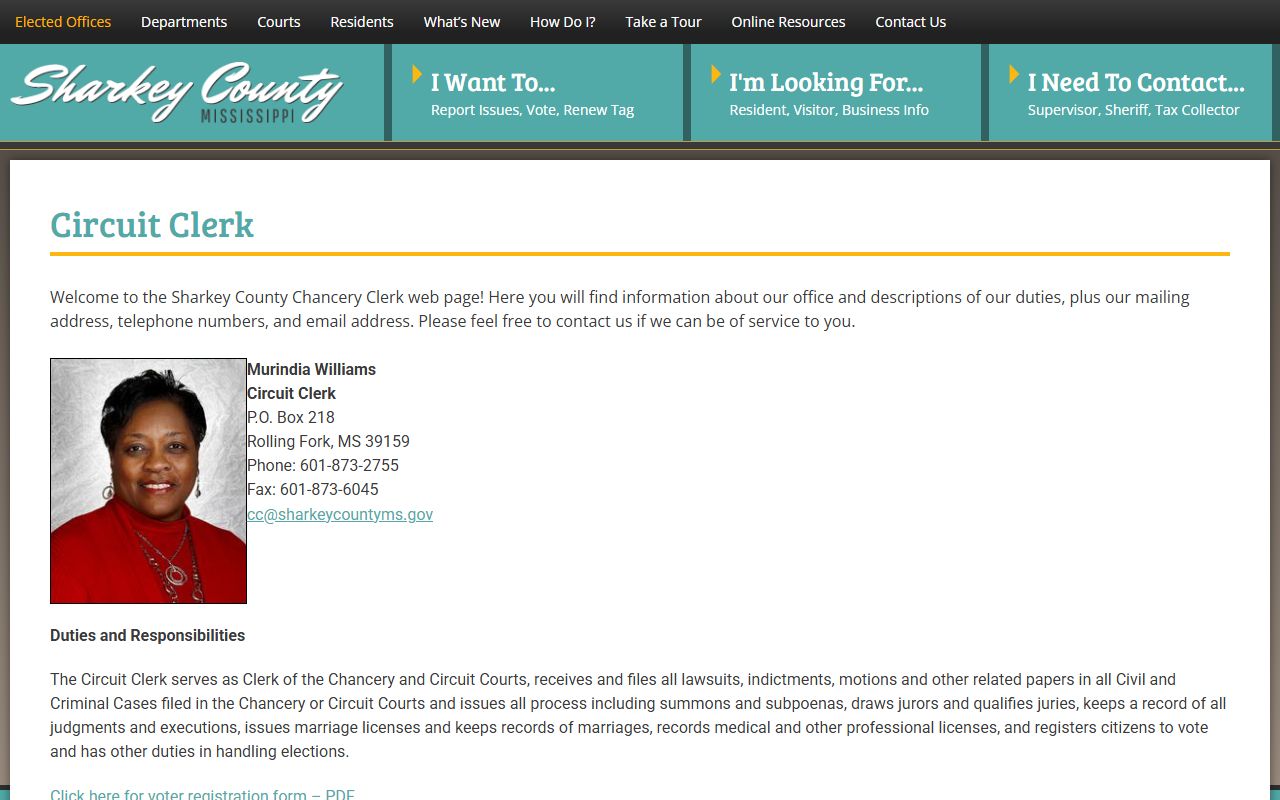
Because the same clerk keeps both civil and criminal Circuit files, one phone call can often confirm whether a record exists and what copy types the office offers.
| Field | What It Shows |
|---|---|
| Case Number | The court's file identifier, often coded by year and court |
| Filing Date | When the complaint, indictment, affidavit, or petition was filed |
| Parties | Plaintiff and defendant, petitioner and respondent, or State and defendant |
| Charges / Cause | The offense charged or the civil claim that started the case |
| Disposition | The outcome, such as dismissed, convicted, settled, or decreed |
| Sentence / Judgment | The penalty or money award the court ordered |
Public Access Laws for Sharkey County Court Records
Mississippi treats most government records as open. The Public Records Act sets the baseline, and court files add their own rules through court orders, sealing, and statutes that protect children and certain case types. For Sharkey County, access starts with the office that holds the record, then bends to whatever confidentiality law applies.
Key Statutes:
Mississippi Code § 25-61-1 - The Public Records Act makes government records open for inspection unless a specific law exempts them.
Mississippi Code § 99-19-71 - Eligible misdemeanor and some felony records may be expunged through the court that handled the case.
Mississippi Code § 43-21-251 - Youth court records stay confidential except where another statute allows release.
Mississippi Code § 43-21-261 - Records involving children may be disclosed only to named persons or by legal authority.
Mississippi Code §§ 93-17-205 to 93-17-209 - Adoption records are confidential and follow a defined statutory access path.
A clean request helps. Name the person or case, the record type, a date range, the case or citation number if known, the copy type you want, and how you would like it returned. The Public Records Act backs requests for sheriff, jail-docket, and county administrative records, but it does not override a sealing order or youth-court confidentiality.
Records That Are Restricted or Confidential
Open access has limits, and Sharkey County honors them like every other Mississippi county. Not every Sharkey County court file is open to a general search. Some files are sealed by a judge, some are confidential by statute, and some carry redactions that hide a part of an otherwise public record. A clerk may even confirm that no public record exists rather than reveal a sealed detail.
Youth court matters fall under Chancery Court here, and those files are closed to ordinary searches. Adoption records are confidential and follow their own statutory path. Mental-health commitment files, also a Chancery matter, hold sensitive medical detail and are treated as restricted. Across case types, Social Security numbers, financial account numbers, minor names, protected addresses, and victim identifiers may be redacted.
To view a sealed record, a person usually must show a legal right to it or ask the court to unseal it. An expunction is different: it removes an eligible record from public view through the court that handled the charge. In Sharkey County that court may be Justice, Municipal, or Circuit, depending on the case. No local expunction packet was found online, so the Circuit Clerk, the Justice Court clerk, or an attorney is the right first call.
Sharkey County Sheriff and Jail
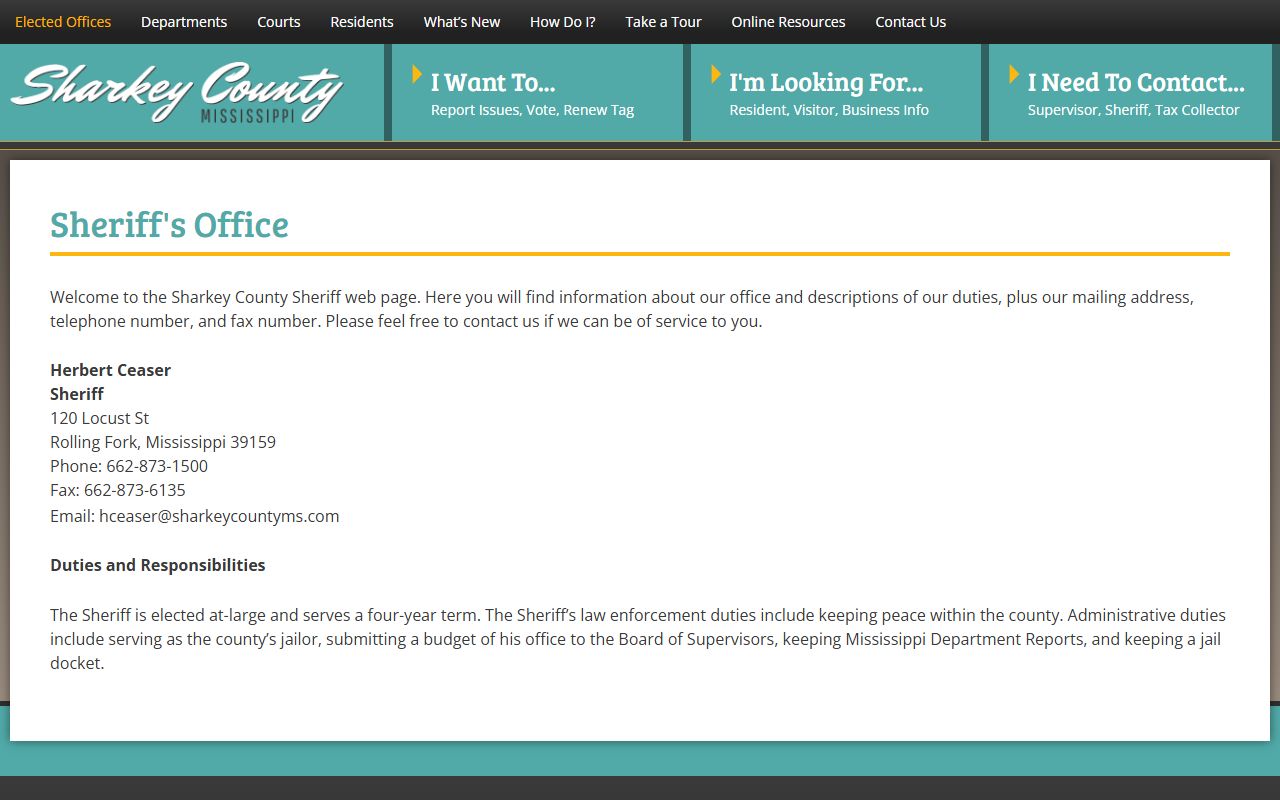
Sheriff Herbert Ceaser leads the Sharkey County Sheriff's Office at 120 Locust Street in Rolling Fork. The sheriff is elected at large for a four-year term, keeps the peace across the county, serves as the county jailor, and keeps a jail docket. The county does not publish an online jail roster, an arrest log, or a booking search, so the Sheriff's Office phone line is the practical channel for custody questions.
An arrest in Sharkey County can lead first to sheriff custody and booking, then to a Justice Court initial appearance. Justice Court judges hold sessions at the jail three times each week so an arrested person gets a first appearance within three days. Felony cases then move toward Circuit Court, while many misdemeanors and tickets stay in Justice Court. The duties of the office are laid out on the Sharkey County Sheriff's Office page.
For custody and booking detail the office handles by phone, the Sharkey County inmate records page maps every lookup channel, and the warrant records page covers active warrants and failure-to-appear orders.
Marriage, Divorce, and Chancery Court Records
Family records in Sharkey County split between two Sharkey County offices. The Circuit Clerk issues marriage licenses and keeps marriage records, while the Chancery Court hears divorce, custody, alimony, and property division. Probate, guardianship, and conservatorship also belong to Chancery Court, which makes the Chancery Clerk the keeper of most estate and family equity files.
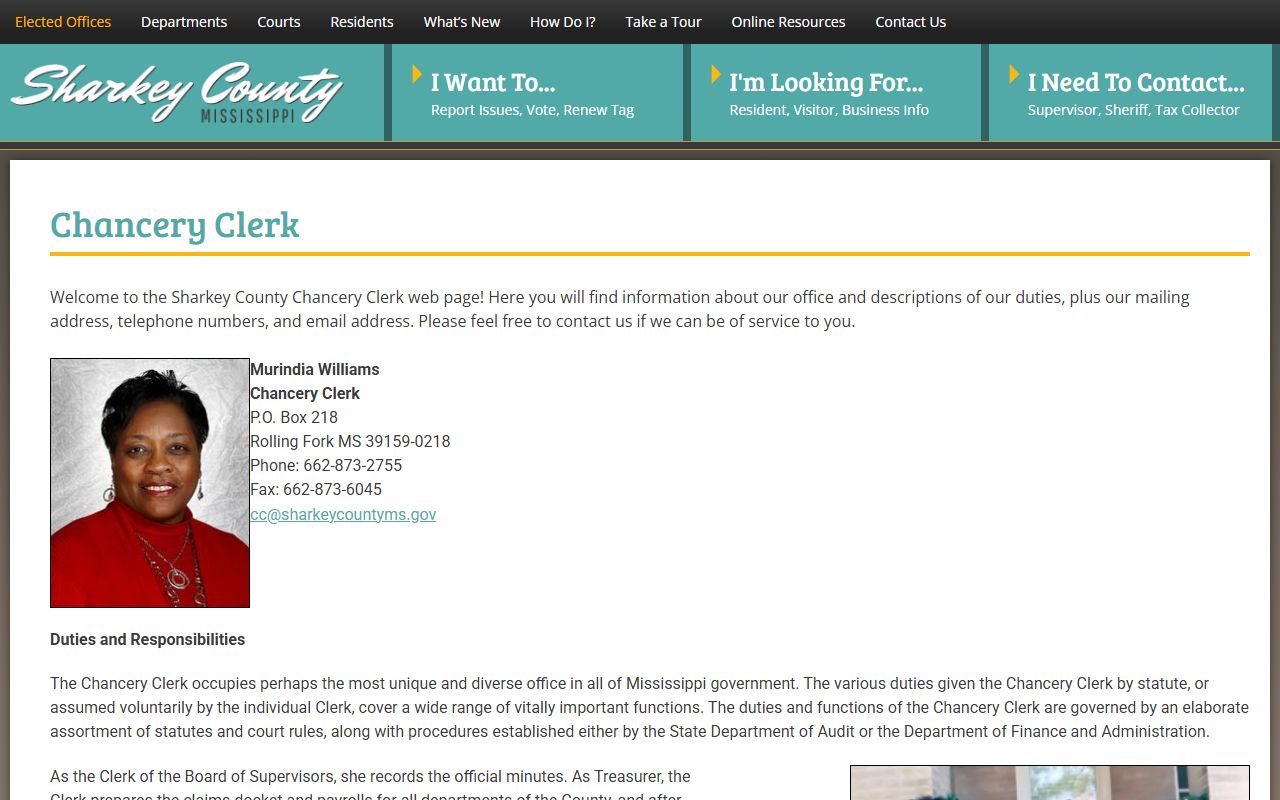
The Chancery Clerk, Murindia Williams, records deeds, mortgages, liens, and military discharges, and serves as clerk for estates, divorces, and adoptions. That broad role is described on the Sharkey County Chancery Clerk page.
For copies, fees, and request steps, the marriage and divorce records page and the probate records page break down each path in detail.
- Testator
- A person who leaves a valid will at death.
- Executor
- The person named in a will to settle the estate.
- Administrator
- The person a court appoints to settle an estate with no will.
- Guardianship
- Court-granted authority to care for a minor or an incapacitated person.
- Conservator
- A person a court names to manage another person's property and finances.
Visiting the Sharkey County Courthouse
The Sharkey County Courthouse at 120 Locust Street in Rolling Fork is more than a service counter. The Mississippi Department of Archives and History records that the building was constructed in 1902, designed by William S. Hull, and built by the firm of F.B. and W.S. Hull. It blends Beaux Arts, Neoclassical, and Italian Renaissance styles and was named a Mississippi Landmark in 1989. Circuit, Chancery, and Justice Courts all keep their offices inside it.
One caution shapes any visit. The March 2023 tornado that struck Rolling Fork damaged the courthouse area, and recovery has continued since. Hours and office operations can shift, so a call ahead is wise before a time-sensitive trip. The building's full history sits on the Mississippi Department of Archives and History property page.
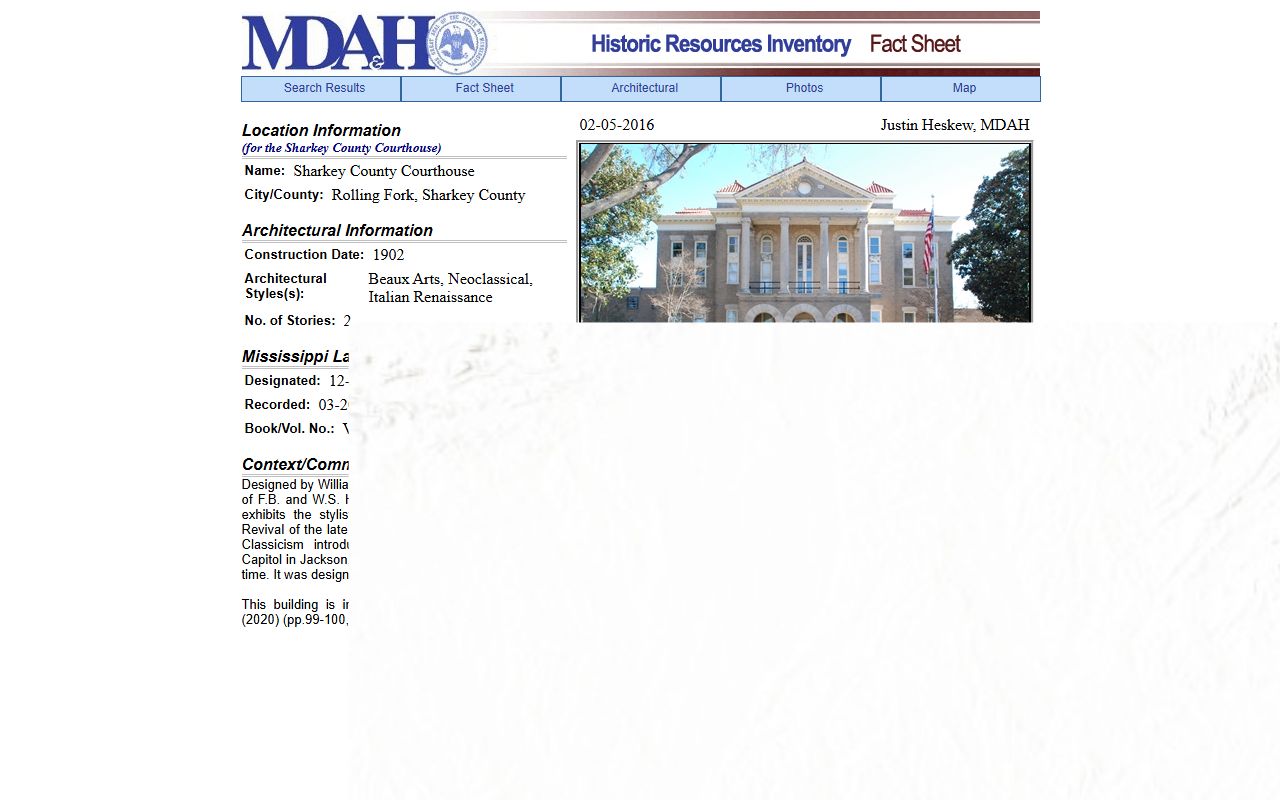
That property page also documents the storm-damage photo set, which is why confirming access before traveling matters for older records and in-person inspection.
Sharkey County Court Records Fees
Fees for copies and certifications vary by office, and Sharkey County does not post a single online price list for its court records. The honest answer for most items is to call the clerk who holds the record and ask before you mail any payment. MEC may also charge to view or download documents, though the current amount was not confirmed on an accessible official page.
The table below reflects what the official county sources actually publish. Where a cell says to contact the clerk, that is because no posted figure was found, not because the service is free.
| Item | Amount |
|---|---|
| Plain copy per page | Contact the clerk for the current fee |
| Certified copy | Contact the clerk for the current fee |
| Marriage license | Contact the Circuit Clerk for the current fee |
| Certified driving record (state DPS) | $14.31 online |
Note: When ordering copies, ask whether the office provides plain, certified, exemplified, or attested versions, since each may carry a different price.
How to Interpret Sharkey County Court Records
A Sharkey County docket can read like code at first. Entries list filings, motions, settings, continuances, and orders in date order, and the abbreviations take a moment to learn. The key distinction in any criminal file is between a charge and a conviction. A charge is only an accusation, while a conviction is a finding or plea of guilt. A disposition is the outcome that closes that question.
Civil and family files use their own labels. A judgment is the court's final decision in a lawsuit, a decree is a Chancery ruling in divorce or probate, and an execution is the step that enforces a money judgment. Status terms such as pending, disposed, dismissed, and satisfied signal where a case stands. When an entry is unclear, the clerk's office can explain what a code means without giving legal advice.
Reading a record carefully also means checking dates. A filing date, a hearing date, and a disposition date can sit far apart, and a case may show activity across several years before it closes.
Accuracy and Record Limitations
Sharkey County court records change as cases move. An entry filed today may be amended, sealed, or corrected next week, and online systems can lag behind the paper file at the counter. In a small rural county, some older records exist only on paper and have never been scanned, which means an online search can miss them entirely.
When a detail carries weight, the safest path is to confirm it with the office that created the record. The Circuit Clerk, the Chancery Clerk, and the Justice Court clerk can each verify the current status of a file they hold. For a felony case that began with a first appearance and later moved to Circuit Court, more than one office may need a call.
Note: Always confirm a name, charge, disposition, or date with the originating Sharkey County office before relying on it for any legal, financial, or personal decision.
History of Sharkey County Courts
Sharkey County was formed in 1876, with Rolling Fork as its county seat. The courthouse built in 1902 remains the working address for Circuit, Chancery, and Justice Courts, which means one civic building carries records for felonies, civil suits, family cases, probate estates, small claims, evictions, and traffic tickets. That concentration matters in a rural county, where the courthouse is the practical access point for several record systems at once.
The county profile maintained by the Mississippi Association of Supervisors lists the same physical and mailing addresses used across the courts today, and it can be viewed on the Mississippi Association of Supervisors Sharkey County page.
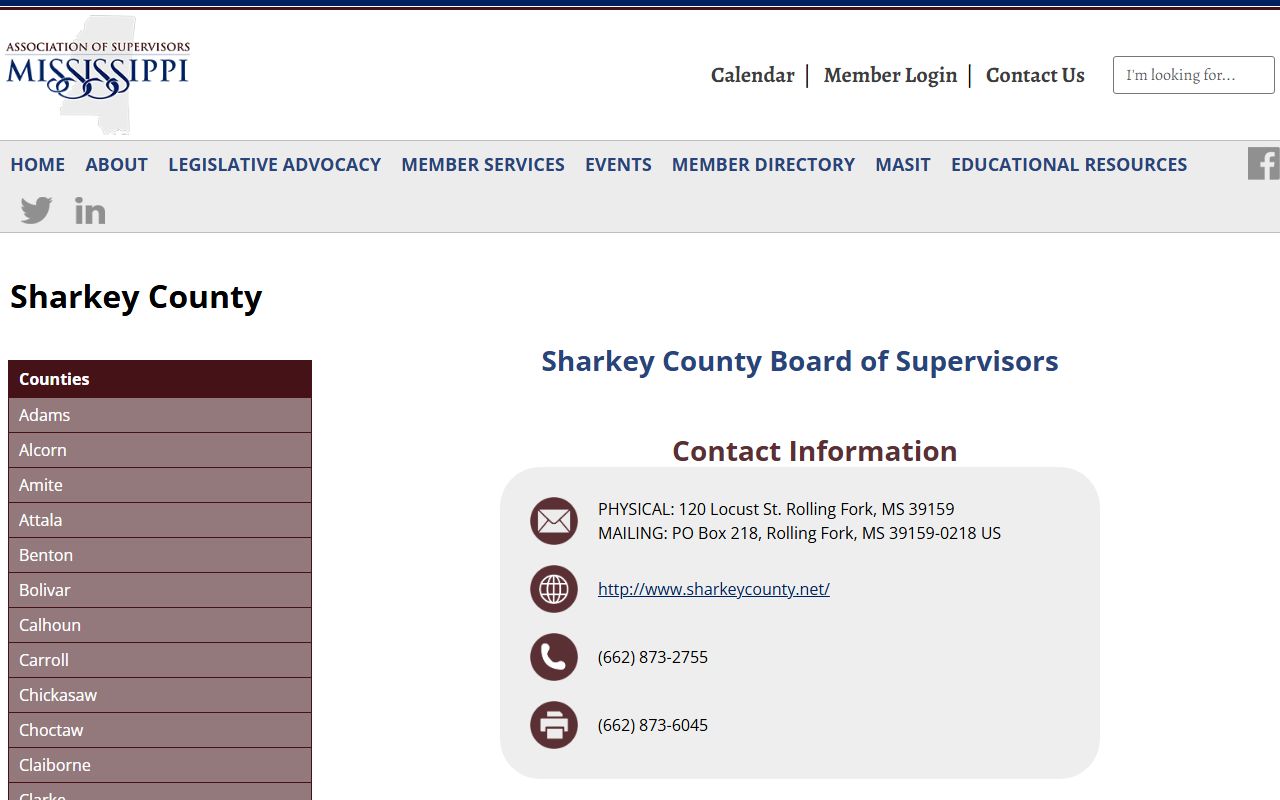
That profile reinforces a simple point for record seekers: in Sharkey County the courthouse address and the clerk's phone line are the constants behind every case search.
Local Context for Records Access
Sharkey County is small and rural, and that shapes how Sharkey County records are reached. Census figures put the population near 3,100, spread across more than 430 square miles of Delta land. Fewer than half of county households hold a broadband subscription, which is part of why phone, mail, and in-person contact often work better here than waiting on a large online system.
These numbers come from the U.S. Census, viewable on the Census QuickFacts Sharkey County page.
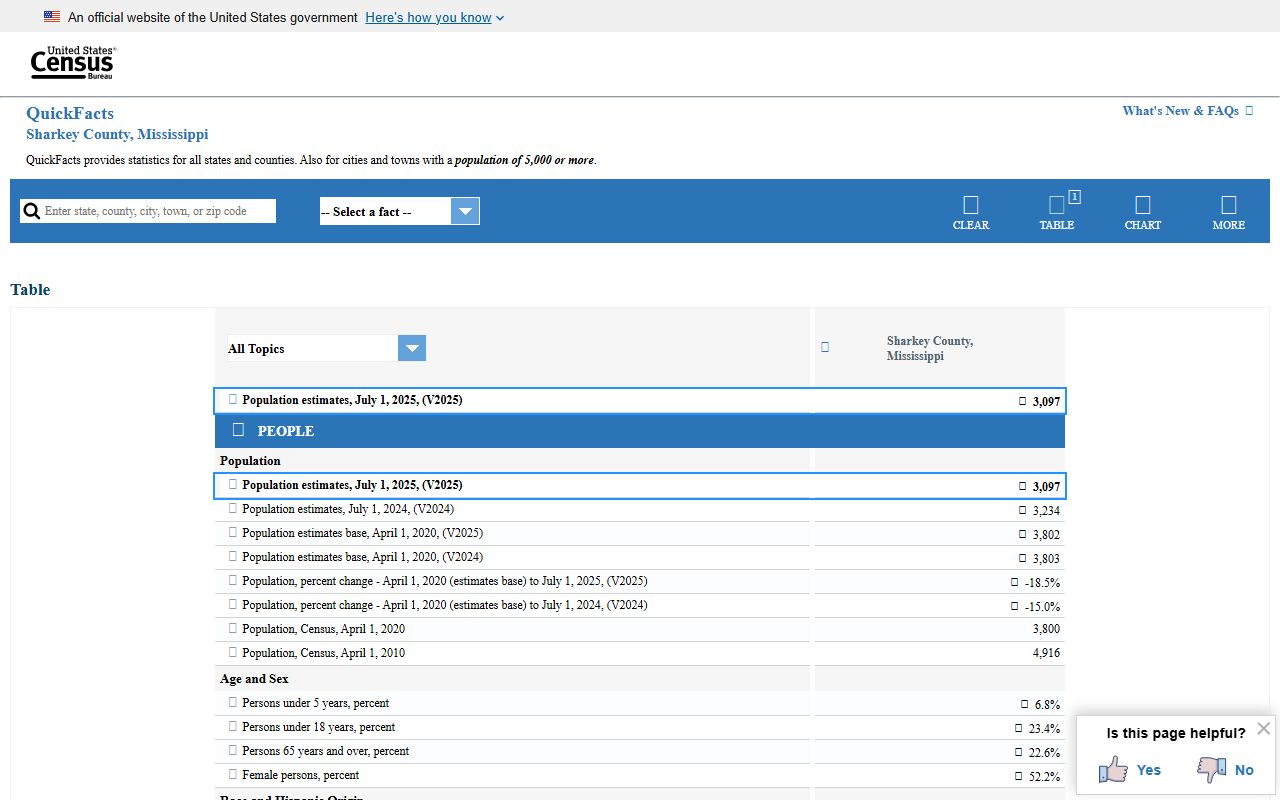
For a records seeker, the takeaway is practical: expect to use the clerk's counter and phone line as much as any database, and confirm office operations before a long drive across the county.
Frequently Asked Questions
Does Sharkey County have a free online case search?
The county does not run its own free public case-search site. Circuit and Chancery cases are reached through Mississippi Electronic Courts, the statewide MEC system, which calls for a login and may charge to view documents. When MEC shows no match or the file is old, the Circuit Clerk or Chancery Clerk at 662-873-2755 is the next step. Justice Court matters are handled through that court at 662-873-6140.
Which court hears my type of case?
Felonies and large civil suits go to Circuit Court. Divorce, custody, probate, guardianship, and land matters go to Chancery Court. Small claims of $3,500 and under, evictions, county traffic tickets, DUIs, and felony first appearances go to Justice Court. City citations may route to a municipal court. Matching the record to the court is the fastest way to find the file in Sharkey County.
Are all Sharkey County court records public?
Most are open under the Mississippi Public Records Act, but several types are closed. Youth court files, adoption records, and mental-health commitments are confidential. Sealed and expunged cases are removed from ordinary public view. Even in an open file, items like Social Security numbers, minor names, and victim identifiers may be redacted. The office that holds the record can confirm what it may release.
How do I get a certified copy?
Contact the clerk who holds the record, since Sharkey County does not post a single online price list. Ask whether the office offers plain, certified, exemplified, or attested copies, and confirm the per-page fee and any certification fee before mailing payment. Certified copies are the versions accepted for legal proceedings, name changes, and similar official uses, so request that type when a court or agency requires it.
How do I check whether someone is in the county jail?
Sharkey County does not publish an online jail roster, so the Sheriff's Office at 662-873-1500 is the working channel for custody questions. For a person sentenced to state prison, the Mississippi Department of Corrections inmate search applies, and the federal Bureau of Prisons locator covers federal custody. The inmate records page on this site maps each of these lookup paths.
Can I clear an old charge from my record?
An expunction may remove an eligible record from public access, and it begins in the court that handled the charge. In Sharkey County that may be Justice Court, Municipal Court, or Circuit Court, depending on the case. A petitioner needs the case number, charge, disposition date, and court. No local expunction packet was found online, so calling the Circuit Clerk, the Justice Court clerk, or an attorney is the right starting point.